Stay Ahead of the Curve
Latest AI news, expert analysis, bold opinions, and key trends — delivered to your inbox.
Amazon Cuts 16,000 Jobs as AI Rewrites Its Workforce
4 min read Amazon is cutting ~16,000 jobs globally to reverse pandemic-era overhiring as it doubles down on AI and automation. The move shows AI shifting from experiments to core operations — fewer people, more machine-driven efficiency. January 28, 2026 11:37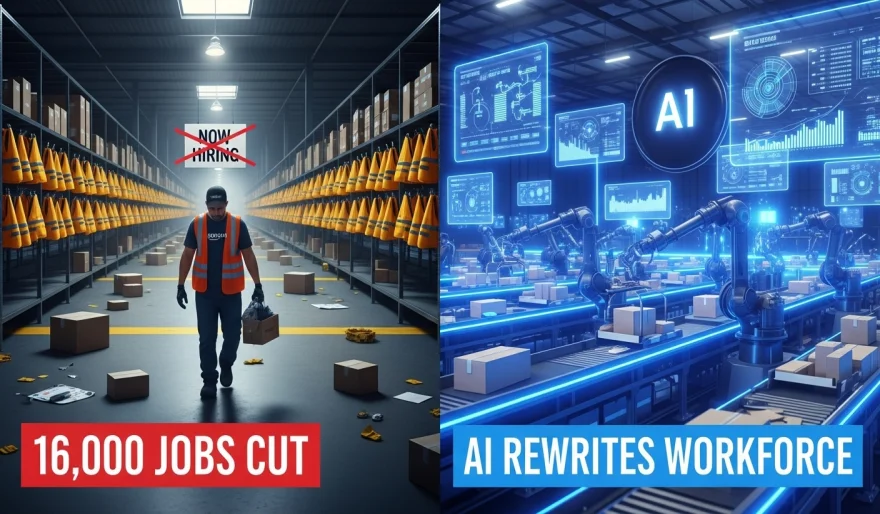
Amazon is laying off around 16,000 employees globally, continuing its effort to unwind aggressive pandemic-era hiring — and accelerating a deeper shift toward AI-driven efficiency.
The cuts span multiple divisions, including corporate roles, as Amazon looks to streamline operations after years of expansion fueled by lockdown-era demand. While cost-cutting is the official reason, the timing is telling: the layoffs come as Amazon ramps up investments in generative AI, automation, and internal AI tooling.
In short, Amazon is shrinking headcount while expanding machine capability.
Why this matters
This isn’t just another “big tech layoff” headline. It’s a signal that AI is no longer experimental inside Amazon — it’s operational. Roles that once scaled with headcount are now being absorbed by AI systems that automate planning, analysis, customer support, logistics optimization, and internal workflows.
The company is effectively trading people-based scale for software-based leverage.
The bigger picture
-
Amazon hired aggressively during COVID to meet e-commerce and cloud demand.
-
Post-pandemic normalization left the company overstaffed.
-
At the same time, AI tools now handle tasks that previously required entire teams.
-
Amazon is also spending billions on AI infrastructure, chips, and model development, especially within AWS.
This pattern mirrors what’s happening across Big Tech — fewer generalist roles, more AI-native systems.
The trade-off
Pros
-
Leaner operations and lower long-term costs
-
Faster execution with AI-augmented teams
-
Stronger margins in a competitive cloud and retail market
Cons
-
Job displacement at massive scale
-
Higher pressure on remaining employees
-
Growing anxiety about AI replacing, not assisting, workers
The takeaway
Amazon’s layoffs aren’t just about fixing past overhiring — they’re about preparing for an AI-first future. The company is betting that fewer humans plus smarter machines beats the old growth-at-all-costs model.
Hot take: We’re entering the era where layoffs aren’t a sign of weakness — they’re a sign that AI is finally being trusted to run core business functions.



















 AI Agents