Amazon is making another quiet but strategic move in the race to automate delivery.
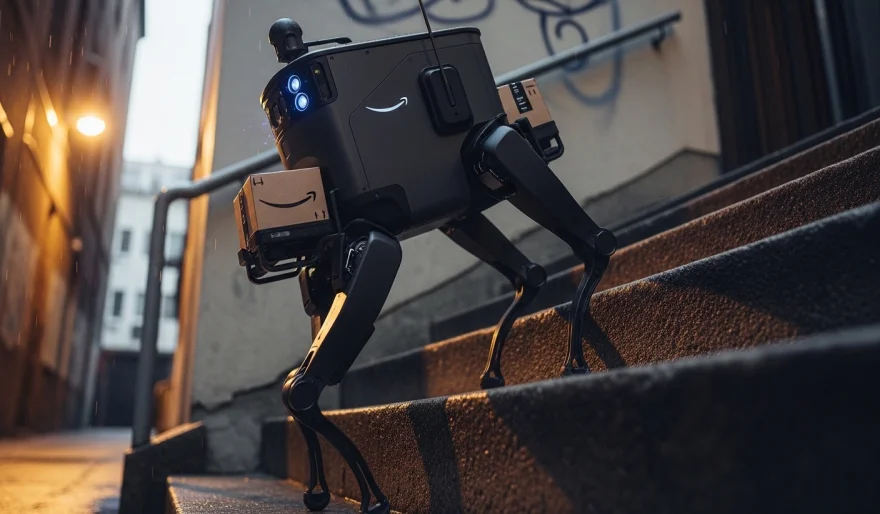
The company has acquired Rivr, a robotics startup known for building a unique kind of delivery bot—one that doesn’t just roll on sidewalks, but can actually climb stairs to reach your doorstep.
It’s a small detail, but a massive unlock.
Last-mile delivery—the final step from warehouse to customer—is one of the most expensive and complex parts of logistics. Most delivery robots today struggle with the real world: stairs, curbs, uneven terrain. Rivr’s approach, described by CEO Marko Bjelonic as a “dog on roller skates,” is designed to solve exactly that.
And that’s what caught Amazon’s attention.
From experiment to scale
Rivr had already been testing its robots in the wild. In 2025, it launched a pilot program in Austin with Veho, aiming to learn how autonomous delivery performs in real-world conditions—and eventually scale to a fleet of 100 robots.
Now, with Amazon in the picture, that timeline could compress fast.
Bjelonic hinted at this in his announcement, pointing to a bigger vision: “general physical AI”—systems that don’t just think, but act in the real world at scale.
In simpler terms: robots that can actually do jobs, not just demos.
Why Amazon is betting here
This isn’t Amazon’s first move in robotics—but it might be one of its most practical.
The company has already invested in Rivr through its Amazon Industrial Innovation Fund, alongside Bezos Expeditions. The startup had raised about $25 million and was valued at around $100 million.
So this acquisition isn’t random—it’s a continuation.
Amazon is building a vertically integrated logistics machine: warehouses, drones, vans, and now potentially stair-climbing robots. Each layer reduces reliance on human labor, cuts costs, and increases delivery speed.
The real shift: AI meets the physical world
For years, AI has mostly lived on screens—chatbots, recommendations, content.
Now it’s moving into the real world.
Robotics like Rivr’s represent a new phase: AI systems that interact with physical environments, navigate unpredictability, and complete tasks autonomously.
That’s much harder than generating text—but far more valuable.
The subtle risk
Real-world AI comes with real-world problems.
Hardware is expensive. Edge cases are everywhere. A robot that works 95% of the time still fails 5% of the time—and in logistics, that matters.
There’s also the human factor: regulation, safety concerns, and public acceptance of robots showing up at your door.
The bigger picture
Amazon isn’t just trying to deliver packages faster.
It’s trying to redefine what delivery looks like—turning it into a fully automated, AI-powered system from warehouse to doorstep.
And Rivr might be the missing piece that gets robots past the final obstacle: your front door.
The takeaway
The future of AI isn’t just smarter software.
It’s machines that can move, adapt, and deliver in the real world.
And Amazon is making sure it gets there first.


















 AI Agents