Stay Ahead of the Curve
Latest AI news, expert analysis, bold opinions, and key trends — delivered to your inbox.
Amazon's Zoox to launch command hub in Arizona, expand testing to Dallas and Phoenix
6 min read Amazon‑owned autonomous vehicle developer Zoox is accelerating its bid to shape the future of driverless taxis, announcing plans for a new command hub in Scottsdale, Arizona, alongside expanded testing operations in Dallas and Phoenix. These moves come as the competitive landscape for autonomous ride‑hailing heats up across the U.S. and regulatory scrutiny intensifies. March 09, 2026 14:42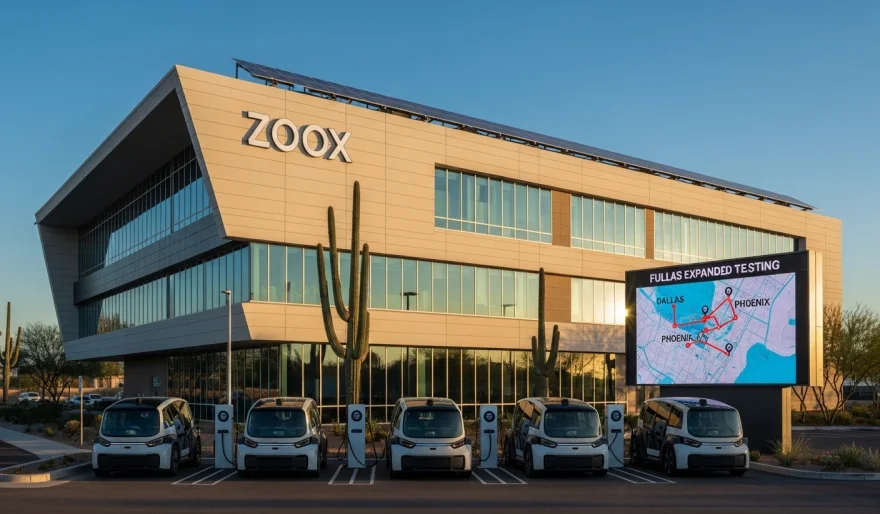
At the heart of Zoox’s latest announcement is the creation of a “Fusion Center” in Scottsdale, Arizona — a centralized nerve center designed to oversee fleet operations, remote support, and real‑time guidance for vehicles on the road. This command hub reflects a strategic shift from isolated test routes to networked, scalable robotaxi infrastructures, where human teams and AI systems collaborate to keep fleets moving smoothly and safely.
The hub will act as the operational backbone for Zoox’s expanding footprint, enabling enhanced coordination across cities and laying the groundwork for eventual commercial deployment.
Testing Across Diverse Terrains
Zoox’s expansion into Dallas and Phoenix isn’t random geography. These sprawling Sun Belt cities offer testing environments starkly different from dense urban centers like San Francisco or Las Vegas. Dallas’s complex road networks and Phoenix’s extreme heat and dusty conditions will provide valuable data for refining sensor performance, battery resilience, and autonomous decision‑making algorithms — critical elements in building reliable self‑driving systems that can handle real‑world chaos.
Initially, the company will deploy a limited number of retrofitted sport utility vehicles for manual mapping, with safety drivers on board to supervise as it prepares for fully autonomous tests.
Scaling Up in the U.S. Robotaxi Race
This latest expansion takes Zoox’s U.S. test markets to about ten, joining locations including Las Vegas, the San Francisco Bay Area, Seattle, Austin, Miami, Los Angeles, Atlanta, and Washington, D.C. The broader strategy is clear: Zoox must diversify its operational footprint if it wants to compete with rivals like Waymo, which have already deployed commercial services in multiple cities, and emerging efforts from others like Tesla and Aurora.
While Waymo has leaned into commercial ride‑hailing in Phoenix and other regions, Zoox’s methodical scaling — regional depots, fusion centers, cross‑city testing — suggests a balance between aggressive expansion and safety‑first validation.
Strategic Timing with Regulatory Focus
Zoox’s announcement arrives just as U.S. regulators convene a national autonomous vehicle safety forum, bringing together leaders from major self‑driving players. This gathering underscores the intense regulatory spotlight on autonomous mobility, where safety metrics, data transparency, and real‑world performance are now table stakes for wider acceptance and eventual commercialization.
By expanding into varied environments and building out operational infrastructure, Zoox is positioning itself not just as a tester but as a contender ready for broader deployment — a message that’s increasingly important as regulators and the public weigh the benefits and risks of driverless technology.
Beyond Mapping: Towards Real‑World Service
Zoox isn’t new to real‑world operations. It has logged over one million autonomous miles and served more than 300,000 riders through pilot programs, including in Las Vegas and select areas of San Francisco, where the company has already begun offering autonomous rides. These earlier efforts provide a performance baseline as Zoox pushes into its next phase of growth.
The Bottom Line
Zoox’s command hub launch and expanded U.S. testing footprint reflect a pivotal moment in the robotaxi race: companies are moving beyond isolated test vehicles to networked, scalable systems meant for real‑world service.
By focusing on diverse geographic environments, strategic operational hubs, and safety‑oriented rollout, Zoox is attempting to distinguish its approach from competitors while navigating a landscape where technology, regulation, and consumer trust must align before truly driverless taxis become a mainstream reality.
This expansion underscores a broader truth in the autonomous vehicle industry: the transition from experimental testing to dependable, everyday service is as much about logistical infrastructure and regulatory readiness as it is about cutting‑edge AI.


















 AI Agents