Stay Ahead of the Curve
Latest AI news, expert analysis, bold opinions, and key trends — delivered to your inbox.
Australia’s CBA Warns AI Costs Are Surging as Complexity Grows
3 min read Australia’s Commonwealth Bank (CBA) has warned that AI costs are rising as businesses apply the technology to more complex tasks, requiring more compute power, oversight, and refinement. The bank also flagged a growing issue it calls “work slop,” where AI-generated outputs are often low quality and still need significant human correction. June 02, 2026 12:05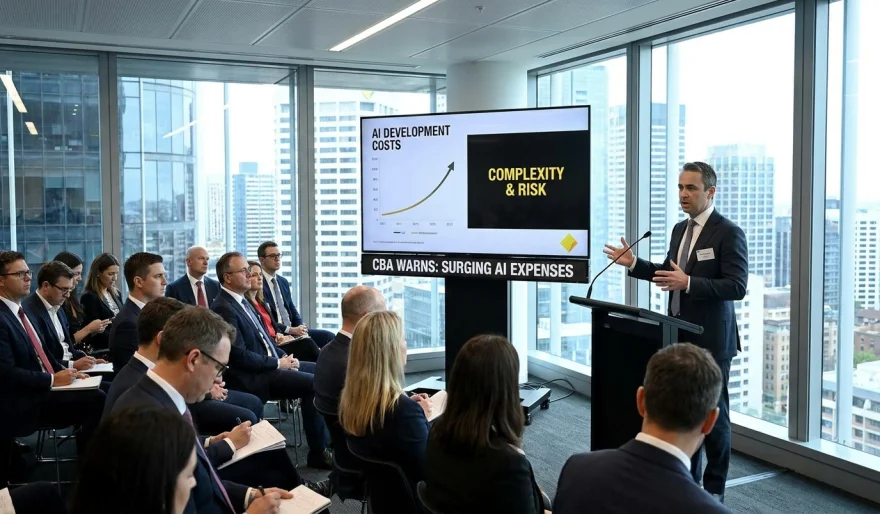
Australia’s Commonwealth Bank (CBA) is raising concerns about the rising cost and operational strain of using AI at scale, as banks and enterprises increasingly deploy AI tools across complex workflows.
The bank says that while AI is improving productivity in some areas, the reality is more complicated: as tasks become more advanced, the cost of running and managing AI systems is climbing sharply. More compute, more oversight, and more refinement are needed to make AI outputs reliable in high-stakes environments like finance.
CBA also highlighted a growing issue it calls “work slop” — referring to low-quality or incomplete AI-generated output that still requires significant human correction. Instead of fully replacing manual work, AI in some cases is shifting effort from creation to cleanup, especially in complex or regulated tasks.
Why it matters is that it challenges one of the biggest assumptions driving the AI boom: that AI automatically reduces cost and workload. In reality, large organizations are discovering a trade-off between speed, quality, and expense, particularly when AI is applied beyond simple tasks like drafting or summarization.
The warning from a major bank adds to a growing global conversation about the true economics of AI. As adoption spreads across industries, companies are starting to realize that scaling AI is not just a technical challenge — it’s a financial one. And in sectors like banking, where accuracy and compliance are non-negotiable, the hidden cost of “AI productivity” may be higher than expected.



















 AI Agents