Stay Ahead of the Curve
Latest AI news, expert analysis, bold opinions, and key trends — delivered to your inbox.
AWS Explains Why Betting on Anthropic and OpenAI Isn’t a Conflict—It’s Strategy
3 min read Amazon Web Services CEO has addressed questions about the company’s multi-billion-dollar investments in Anthropic and OpenAI, framing it not as a conflict but as a strategic hedge in a hyper-competitive AI landscape. April 09, 2026 13:02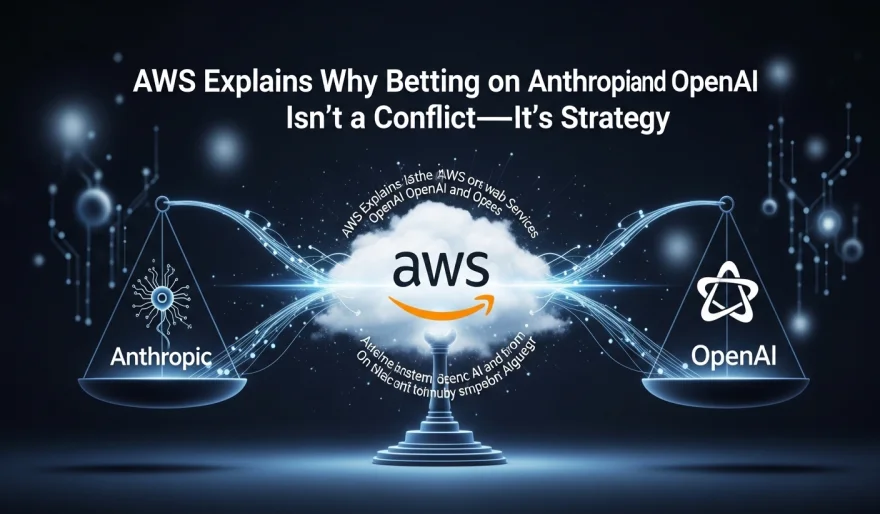
Investing in multiple AI competitors at once sounds… messy.
Wouldn’t that create tension? Or even compromise neutrality?
AWS says no—and there’s logic to it.
At the heart of the explanation: compute is the currency, not ownership.
Both Anthropic and OpenAI need massive cloud infrastructure to train and deploy their models. By providing it, AWS isn’t just selling servers—it’s cementing itself as the backbone of the AI industry.
That means:
– AWS benefits regardless of which AI model dominates.
– The company captures revenue and strategic data without picking a “winner.”
– Supporting multiple players accelerates innovation, which in turn drives more demand for cloud compute.
It’s a bet on the ecosystem, not the company.
This approach also signals a broader reality: AI isn’t just a tech race—it’s a compute race. Companies like AWS, Microsoft Azure, and Google Cloud aren’t just providing tools; they’re powering the winners. The more models they host, the more entrenched they become in the AI stack.
There’s a subtle advantage in diversification too. By backing multiple AI leaders, AWS avoids:
– Overexposure to any single model’s failures
– The risk of a competitor locking them out of future contracts
– Missing out on emerging breakthroughs
But there’s a nuance. Serving multiple competing AI clients could raise ethical or operational tensions, especially around:
– Resource prioritization
– Proprietary improvements
– Confidential research
Still, AWS believes the benefits outweigh the potential friction—and the message is clear: in AI, infrastructure is influence.
Why it matters:
AWS isn’t just a vendor—it’s a strategic player in AI. By backing multiple model leaders, it strengthens its dominance while insulating itself from volatility in a fast-moving industry.
Forward look:
Expect more cloud providers to adopt this multi-client strategy. In the AI age, ownership isn’t as valuable as control over the pipelines powering the future of intelligence.

















 AI Agents