Stay Ahead of the Curve
Latest AI news, expert analysis, bold opinions, and key trends — delivered to your inbox.
CES 2026: AI isn’t a feature anymore — it’s the foundation
6 min read CES 2026 showed AI is no longer a feature — it’s the foundation. Nvidia’s Rubin chips, AMD’s Ryzen AI, Razer’s wild wearables, and smarter robots signal that the next wave of AI will live everywhere: PCs, phones, and the real world. January 07, 2026 11:48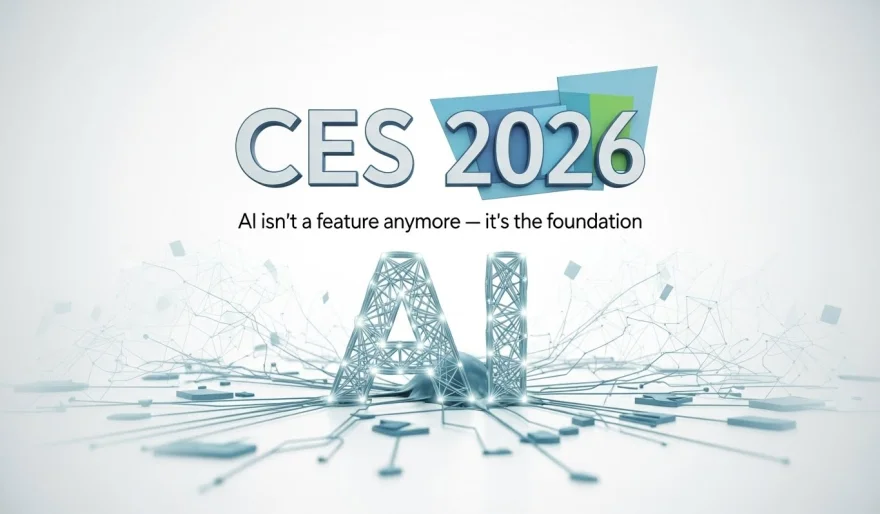
CES 2026 in Las Vegas made one thing clear: AI is no longer just a buzzword. It’s now the base layer of computing, shaping everything from gaming rigs to wearables, robots, and data centers. This year’s show gave us a peek at where the industry is heading — and why the next wave of AI adoption won’t just be about software, it’ll be about hardware, accessibility, and real-world experience.
Nvidia: Supercharging AI everywhere
Nvidia kicked off the show with its Vera Rubin architecture, a next-gen AI chip platform designed for massive scale training and inference. Think faster, more efficient AI models running from cloud servers to autonomous vehicles. On the consumer side, updates like DLSS 4.5 for gaming and G-SYNC Pulsar monitors with AI sensing show Nvidia is blending cutting-edge performance with tangible user experiences.
The signal is clear: Nvidia is betting on infrastructure first. If you want to build the future of AI applications, you’ll need Rubin-class compute under the hood.
AMD: AI for every PC, not just the data center
AMD took a broader approach. Its Ryzen AI 400 Series chips bring AI acceleration to everyday laptops and desktops, meaning things like smarter multitasking, faster transcription, and real-time creative workflows could soon be standard.
For developers and data centers, AMD previewed the MI500 series GPUs and the rack-scale Helios AI system, a direct challenge to Nvidia’s dominance. AMD’s pitch is ambitious: AI should live everywhere, from gaming PCs to cloud-scale workloads, democratizing access and letting more users interact with AI locally rather than via cloud servers.
Razer: AI gets weird (and fun)
Razer went full experimental. Its Project Motoko headphones feature AI-powered cameras and assistant capabilities — think a wearable that sees, listens, and responds. Meanwhile, Razer’s AI development workstations aim at creators and devs, not consumers.
These concepts are playful, but they hint at the next frontier: ambient AI experiences. The goal isn’t just smarter computers; it’s AI that actively participates in your life. That’s exciting, but it also raises questions about privacy, adoption, and practical utility.
Robots, smart devices, and the physical AI layer
Beyond chips and wearables, AI is spreading into the real world. Boston Dynamics showed robots with language understanding, autonomous vehicles got smarter, and even toys and home devices are learning to interact more intelligently. The lesson? AI is no longer confined to a screen. It’s becoming a real-world interface, shaping how we live, work, and play.
Why it matters
CES 2026 proves that AI isn’t a product feature — it’s the foundation of computing. What happens at the hardware level now directly determines what software can do. Chips, NPUs, and local acceleration will decide speed, cost, privacy, and accessibility of AI for years to come.
-
For users: Expect faster, smarter, more personalized experiences — but don’t assume everything will ship immediately. Many demos are roadmaps, not store shelves.
-
For developers: Platform diversity is both an opportunity and a headache. Optimizing for AMD, Nvidia, or specialized silicon will become a core skill.
-
For the market: Hardware competition will drive both innovation and cost efficiency, but it will also shape who can access high-end AI tools and who remains locked out.
The takeaway
CES 2026 isn’t about gadgets. It’s a preview of AI’s infrastructure-driven future. The chips you use, the devices you own, and the platforms you build on will define how AI fits into everyday life. And for companies, this means one thing: if you’re serious about AI, you can’t just focus on models and software — you need to think about the whole stack, from silicon to sensors to real-world deployment.

















 AI Agents