Stay Ahead of the Curve
Latest AI news, expert analysis, bold opinions, and key trends — delivered to your inbox.
Cursor Built Its New Coding AI on Kimi — And Just Admitted It
4 min read Cursor has acknowledged that its latest coding model is built on top of technology from Moonshot AI’s Kimi. The reveal highlights how even fast-rising AI tools are stacking on top of each other in the race to ship faster. March 23, 2026 11:51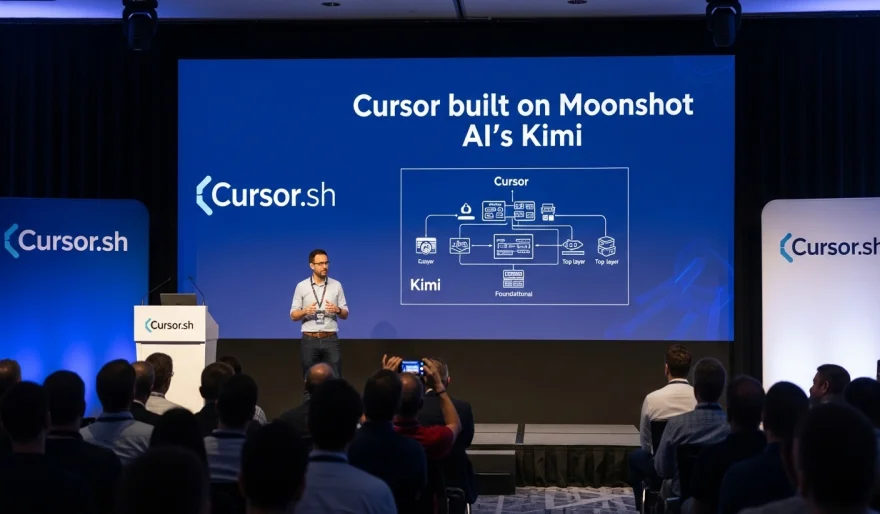
Cursor just pulled back the curtain on its newest model—and what it revealed says a lot about how AI is actually being built today.
The company admitted that its latest coding system is built on top of Kimi, a model developed by Moonshot AI.
On the surface, that might sound surprising. Cursor has been positioning itself as a cutting-edge AI coding tool, competing in a space dominated by giants. But under the hood, it’s leveraging existing foundation models to move faster.
And that’s the real story.
AI is becoming a stack, not a single product
We’re entering a phase where AI companies aren’t always building everything from scratch.
Instead, they’re layering.
Foundation models like Kimi provide the base intelligence. On top of that, companies like Cursor add specialized features—developer workflows, integrations, UI, and fine-tuning for specific use cases.
It’s similar to how software evolved in the past: not everyone builds the operating system, but many build powerful apps on top of it.
Why this matters
Speed is everything in AI right now.
Training a frontier model from scratch costs billions and takes massive infrastructure. By building on top of an existing model, Cursor can iterate faster, ship features quickly, and focus on user experience instead of raw model training.
For developers, this often translates to better tools, faster updates, and more practical functionality.
The subtle risk
There’s a trade-off.
Relying on another company’s model introduces dependency. If the underlying provider changes pricing, access, or performance, it directly impacts the product built on top.
There’s also the question of differentiation. If multiple tools build on the same foundation, how unique can they really be?
The bigger picture
This moment reflects a broader shift in the AI ecosystem.
A few companies build the core models. Many others build on top.
It’s creating a layered market:
-
Foundation layer (model builders)
-
Application layer (tools like Cursor)
-
Integration layer (enterprise workflows)
And each layer has its own winners.
The takeaway
Cursor’s admission isn’t a weakness—it’s a signal.
The AI race isn’t just about who builds the model.
It’s about who builds the best product on top of it.



















 AI Agents