When Elon Musk says OpenAI was his idea and later got “looted,” it’s not just a dramatic soundbite—it’s a direct attack on how one of the most important AI companies in the world evolved.
To understand the weight of that claim, you have to go back to 2015.
OpenAI was founded as a nonprofit AI lab, with a clear mission: build artificial intelligence that benefits humanity, openly and safely. Musk was one of the early backers and public faces of that vision. The idea was simple but radical—AI shouldn’t be controlled by a few corporations.
Fast forward to today, and OpenAI looks very different.
The Pivot: From Open to Closed (and Very Valuable)
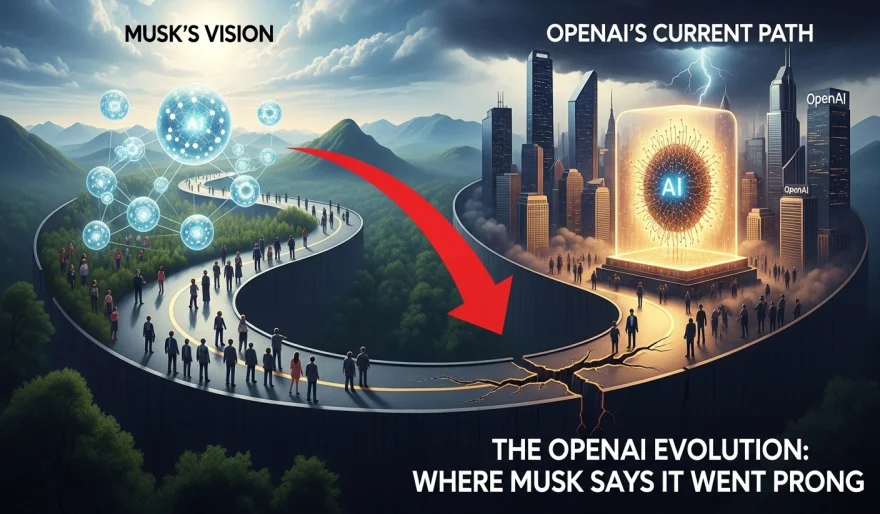
Over time, OpenAI shifted from a pure nonprofit into a “capped-profit” structure, allowing it to raise massive funding while still claiming a public-interest mission.
That shift accelerated when Microsoft entered the picture—pouring in billions, integrating OpenAI models into its products, and effectively becoming its biggest commercial partner.
From Musk’s perspective, this is where things went off the rails:
-
The “open” in OpenAI became more selective
-
Models became increasingly closed and proprietary
-
The company aligned itself with one of the biggest tech giants in the world
In short: the anti-Big Tech AI lab became deeply tied to Big Tech.
The Breakup: Why Musk Left
Musk exited OpenAI’s board in 2018. Officially, it was to avoid conflicts with Tesla’s AI work. Unofficially, reports and later comments suggest disagreements over direction and control.
Since then, Musk has grown more vocal—and more aggressive:
-
He has accused OpenAI of abandoning its founding principles
-
He has criticized its close relationship with Microsoft
-
He has even taken legal action, framing the shift as a betrayal of its original mission
His latest “looted” comment fits into that broader narrative:
that OpenAI didn’t just evolve—it deviated.
Meanwhile: OpenAI’s Side of the Story
From OpenAI’s perspective, the transformation wasn’t betrayal—it was survival.
Training cutting-edge AI models like GPT-4 and beyond requires:
-
Massive compute infrastructure
-
Billions in capital
-
Strategic partnerships
Without commercialization, OpenAI arguably wouldn’t have been able to scale fast enough to compete with rivals like Google or Meta.
So the trade-off became clear:
Stay pure and small—or scale and compromise.
OpenAI chose scale.
Enter xAI: This Isn’t Just Criticism—It’s War
Musk didn’t just walk away—he’s building a rival.
His company, xAI, is positioned as an alternative to OpenAI, with a different philosophy (at least in messaging): more transparency, less corporate capture, and a focus on “truth-seeking” AI.
But here’s the twist:
xAI is also raising billions, buying GPUs, and competing in the same high-cost ecosystem.
So even Musk is playing the same game—just under a different banner.
The Real Conflict: Ideology vs Reality
This feud exposes something bigger than personalities:
AI has an identity crisis.
On paper, the goals sound noble:
-
Build safe AI
-
Share benefits broadly
-
Avoid concentration of power
In reality, the industry runs on:
-
Enormous capital requirements
-
Closed models for competitive advantage
-
Strategic alliances with tech giants
So the question becomes:
Can AI ever truly be “open” at scale?
Musk says OpenAI failed that test.
OpenAI would argue the test itself is flawed.
Why This Matters (Beyond the Drama)
This isn’t just founder ego—it’s about who controls the future of intelligence.
If AI development stays concentrated among a few players:
-
Innovation could accelerate
-
But power becomes centralized
If it becomes more open:
-
Access improves
-
But safety, misuse, and coordination risks increase
That tension is still unresolved—and Musk vs OpenAI is just the most visible version of it.
The Takeaway:
Musk’s “they looted it” claim is less about the past—and more about shaping the narrative of the future.
Because whoever wins that narrative…
gets to define what AI is for.

















 AI Agents