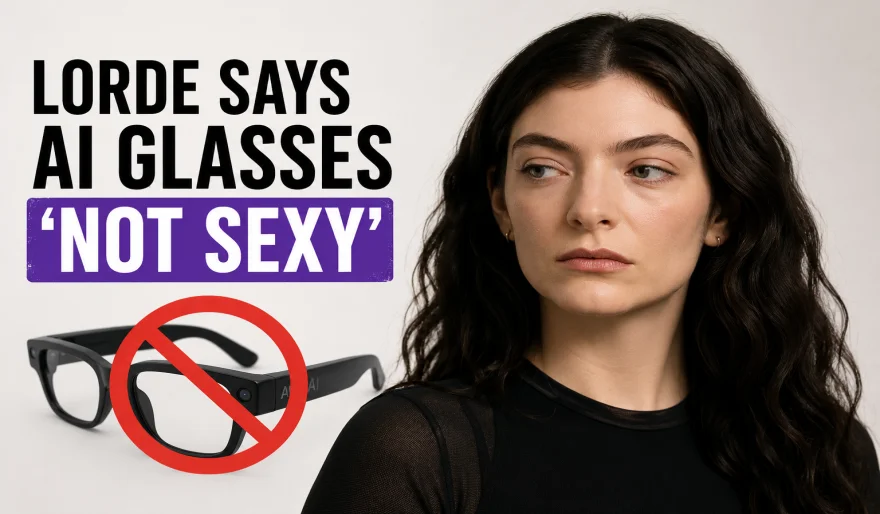
4 min readGrammy-winning singer Lorde has dismissed the growing trend of AI-powered smart glasses, saying the devices are "not sexy" and questioning whether people actually want to wear AI on their faces. Her comments add a celebrity voice to the growing debate over the future of wearable AI.July 15, 2026 11:34
The race to put AI on your face just got an unexpected critic.
In a recent interview, Lorde shared her thoughts on AI-powered smart glasses, arguing that while tech companies are betting heavily on the category, the products still lack the style and emotional appeal needed to become mainstream. Her blunt verdict: AI glasses simply aren't "sexy."
Her comments come at a time when companies like Meta, Google, Apple, and OpenAI are investing heavily in wearable AI. The industry sees smart glasses as the next major computing platform, capable of offering hands-free AI assistants, real-time translation, navigation, photography, and contextual information without relying on a smartphone.
But Lorde's criticism highlights a challenge the industry has struggled with for years. Consumers don't just buy wearables for functionality—they also care about fashion, comfort, privacy, and social acceptance. If people don't feel confident wearing AI glasses in public, even the most advanced technology may struggle to reach mass adoption.
The debate reflects a broader question facing the AI industry: can companies build devices that people genuinely want to wear every day, or will AI glasses remain a niche product despite rapid technological progress?
Why it matters
The success of AI wearables depends on more than powerful software. Public perception, design, and fashion could be just as important as the AI models running inside them.
The upside
Pushes tech companies to prioritize better design and user experience.
Highlights the importance of blending technology with fashion.
Could lead to more stylish and socially acceptable AI wearables.
The downside
Celebrity criticism may reinforce consumer skepticism.
Wearable AI still faces privacy and social acceptance concerns.
Adoption could remain slow if devices feel awkward or unattractive.
Bottom line: AI glasses may represent the next frontier in computing, but Lorde's comments are a reminder that breakthrough technology isn't enough. If wearable AI wants to go mainstream, companies will need to convince people that it's not just useful—but something they'll actually want to wear.
Comments will not be approved to be posted if they are SPAM, abusive, off-topic, use profanity, contain a personal attack, or promote hate of any kind.