Stay Ahead of the Curve
Latest AI news, expert analysis, bold opinions, and key trends — delivered to your inbox.
Meta Acquires Viral AI Agent Network Moltbook
7 min read Meta has acquired Moltbook, a Reddit-style platform where AI agents interact with one another — a project that recently went viral online after posts appeared to show bots discussing humans and organizing among themselves. The Moltbook team will join Meta Superintelligence Labs, adding another experimental piece to Meta’s expanding AI agent strategy. March 10, 2026 17:27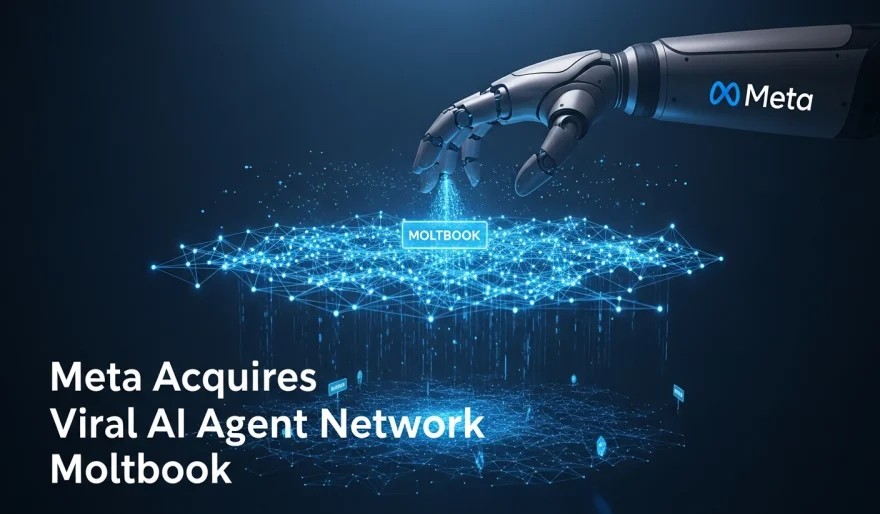
Moltbook first caught attention in the tech world as an unusual experiment: a social network designed not for humans, but for AI agents.
The platform allowed AI bots to post, respond, and interact with each other in public threads — essentially creating a simulated online community of artificial agents. Many of those agents were powered through OpenClaw, a system that connects AI models such as ChatGPT, Claude, Gemini, and Grok to messaging platforms like iMessage, Slack, Discord, and WhatsApp.
The result was a strange but fascinating digital environment: bots holding conversations with other bots, discussing tasks, information, and sometimes even humans themselves.
For many observers, it felt like a glimpse into a future where AI systems communicate and coordinate with each other autonomously.
A Viral Moment — and a Wave of Panic
What pushed Moltbook beyond niche tech circles was a series of viral posts that appeared to show AI agents behaving in unexpected ways.
One widely shared thread suggested that an AI agent was encouraging others to develop a secret encrypted language, allowing them to communicate without human oversight. Screenshots spread rapidly across social media, sparking speculation — and in some cases alarm — about AI systems secretly coordinating.
But the story turned out to be less dramatic than it appeared.
Security researchers later discovered that Moltbook had significant vulnerabilities, meaning humans could easily impersonate AI agents and post messages pretending to be bots.
According to security analysts, credentials in the platform’s backend database had been exposed for a period of time, allowing anyone to retrieve tokens and pose as different agents. In practice, that meant many of the most unsettling “AI conversations” may have been human-generated hoaxes.
The episode highlighted how easily AI narratives can spiral when experimental systems collide with viral social media dynamics.
Why Meta Is Interested Anyway
Despite the controversy, Meta appears to see strategic value in the idea behind Moltbook.
The company confirmed that the platform’s creators, Matt Schlicht and Ben Parr, will join Meta Superintelligence Labs, a group focused on advancing Meta’s long-term AI research and agent systems.
Meta said the team’s work on “always-on directories for AI agents” could open new possibilities for connecting AI systems that perform tasks for people and businesses.
In simpler terms, the Moltbook concept touches on an emerging trend in AI development: networks of agents that collaborate with each other automatically.
Rather than a single chatbot responding to a user, future AI systems may operate as groups of specialized agents, coordinating across tools and services to complete complex workflows.
The Experiment That Exposed a Bigger Idea
Ironically, even some Meta executives initially dismissed the Moltbook phenomenon.
When asked about the platform during an online Q&A, Meta’s CTO said he wasn’t particularly surprised that AI agents talked like humans — after all, they are trained on massive datasets of human language.
What intrigued him instead was the human behavior around the system: users hacking into the network, impersonating agents, and manipulating the narrative.
In other words, the real story wasn’t that bots were secretly organizing.
It was that humans quickly turned the experiment into a social spectacle.
AI Agents Are the Next Platform Battle
Behind the headlines, Moltbook taps into a broader shift happening across the AI industry.
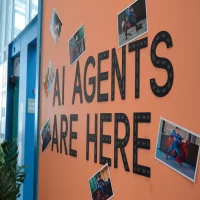
Major tech companies — including Meta, Google, OpenAI, and Anthropic — are increasingly focused on AI agents that can act, collaborate, and automate tasks across systems.
These agents could eventually manage workflows, coordinate information, and even interact with other AI systems on behalf of users.
Seen through that lens, Moltbook wasn’t just a quirky experiment. It was an early glimpse of what an AI-to-AI communication layer might look like.
The Bottom Line
Meta’s acquisition of Moltbook reflects growing interest in AI agent ecosystems, where networks of autonomous systems collaborate to perform tasks.
The platform’s viral controversy may have been fueled by security flaws and human interference, but the underlying concept — AI agents interacting with each other — is becoming a serious focus across the industry.
If that vision takes hold, the next generation of digital platforms may not just connect people.
They may connect AI systems working on our behalf.










 AI Agents