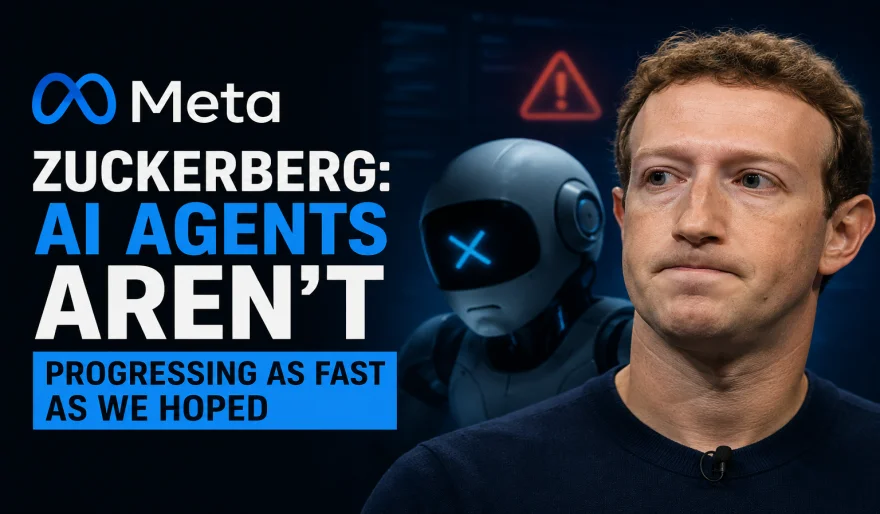
Meta Admits AI Agents Aren't Replacing Workers as Fast as Expected
4 min readMark Zuckerberg says AI agents are improving, but they're not advancing quickly enough to replace human work at the pace Meta originally anticipated.July 03, 2026 12:44
For the past year, the AI industry has been selling a bold vision: autonomous AI agents capable of handling entire jobs with little to no human oversight.
Now, one of AI's biggest believers is acknowledging that reality is proving more complicated.
According to Reuters, during an internal town hall on Thursday, Meta CEO Mark Zuckerberg told employees that the company's AI agent development has not "accelerated in the way" leadership had expected. The comment is notable because Meta has been one of the loudest companies pushing AI-powered assistants, coding agents, and digital workers capable of automating knowledge work.
The admission highlights a growing gap between AI demos and real-world deployment.
While today's AI models are remarkably capable at writing code, researching information, and assisting with repetitive tasks, building agents that can reliably complete complex, multi-step work without constant human supervision remains one of the industry's toughest technical challenges.
Meta isn't alone.
OpenAI, Anthropic, Google, Microsoft, and Amazon are all racing to build autonomous AI agents, but even the most advanced systems still struggle with long-running tasks, consistency, memory, and decision-making in unpredictable environments.
That means the future many predicted—where AI agents rapidly replace large portions of office work—is arriving more slowly than early forecasts suggested.
Why it matters
This is one of the clearest signs yet that even the companies building frontier AI recognize the limitations of current agent technology. Despite enormous investment, replacing human workers is proving significantly harder than creating impressive AI demonstrations.
The upside
The slower rollout gives businesses more time to integrate AI thoughtfully, improve workflows, and keep humans in the loop instead of rushing into full automation.
The downside
Companies that have built strategies around rapid AI-driven workforce reductions may need to reset expectations, while investors betting on near-term AI agent breakthroughs could face a longer wait.
Looking ahead
AI agents are still improving rapidly, but Zuckerberg's comments suggest the next major leap won't come from hype alone. The companies that solve reliability—not just intelligence—are likely to define the next phase of the AI race.
Comments will not be approved to be posted if they are SPAM, abusive, off-topic, use profanity, contain a personal attack, or promote hate of any kind.