Stay Ahead of the Curve
Latest AI news, expert analysis, bold opinions, and key trends — delivered to your inbox.
Meta just bought Manus — and this time, it’s not just hype
5 min read Meta has acquired AI startup Manus for $2 billion, betting on one of the few AI agent companies with real traction and revenue. Manus, known for AI agents that handle tasks like hiring, travel planning, and stock analysis, reportedly has millions of users and over $100M in ARR. Meta plans to integrate Manus into Facebook, Instagram, and WhatsApp while keeping it independent — a clear signal that Big Tech is shifting from flashy AI demos to AI products that actually make money. December 30, 2025 10:52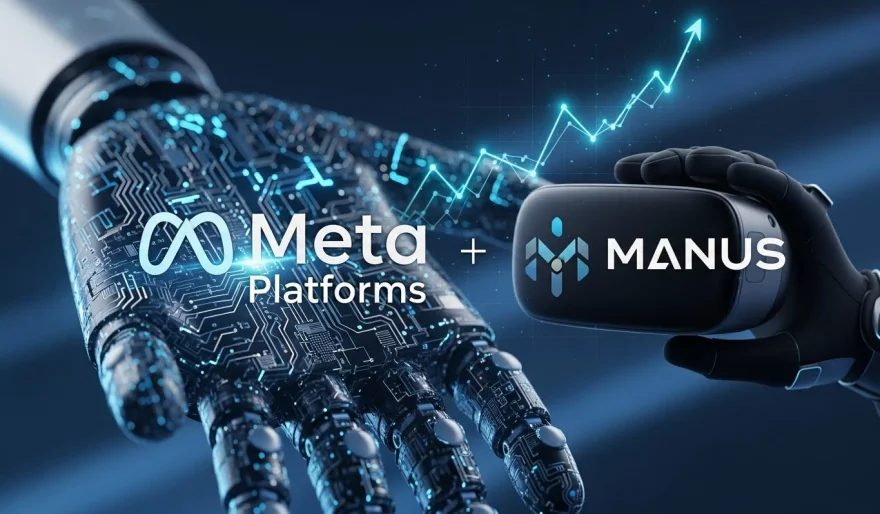
Mark Zuckerberg isn’t slowing down. Meta is acquiring Manus, the buzzy AI startup that’s been quietly turning Silicon Valley heads into believers — and more importantly, turning AI demos into real revenue.
If you remember Manus, it’s the Singapore-based startup that went viral earlier this year after releasing a demo showing an AI agent screening job candidates, planning full vacations, and analyzing stock portfolios end-to-end. At the time, Manus even claimed it could outperform OpenAI’s Deep Research — a bold statement that suddenly didn’t feel so bold once people tried it.
Fast forward a few months, and the startup isn’t just a demo darling anymore. Manus now claims millions of users and over $100 million in annual recurring revenue. That’s the moment Meta came knocking.
According to reports, Meta is paying $2 billion for Manus — the same valuation the startup was reportedly targeting for its next funding round. Just weeks after launch in April 2025, Manus had already raised $75 million at a $500 million valuation, led by Benchmark, with backing from Tencent, ZhenFund, and Sequoia China (now HSG). That’s a meteoric rise by any standard.
Why this deal matters
This acquisition is different from Meta’s usual AI shopping spree.
Meta has been spending aggressively — over $60 billion on AI infrastructure — and investors have been getting increasingly uneasy about when (or if) that spend turns into actual business value. Manus changes that conversation. It’s not just another foundational model or research lab; it’s a proven AI product that already makes money.
In other words, Zuckerberg didn’t just buy intelligence — he bought traction.
Manus also gives Meta something it’s been chasing: agentic AI that actually works in the real world. These aren’t chatbots answering trivia. These are AI agents that complete multi-step tasks, make decisions, and deliver outcomes — exactly the direction the AI industry is heading.
What Meta plans to do with Manus
Meta says Manus will continue operating independently, but its AI agents will be woven into Facebook, Instagram, and WhatsApp, where Meta AI already lives. That’s a massive distribution advantage overnight — and potentially a huge leap forward in making AI agents feel genuinely useful to everyday users, not just power users.
Imagine AI agents that don’t just chat in WhatsApp, but actually book trips, vet candidates, manage finances, or plan events inside apps billions of people already use.
That’s the real play here.
The bigger picture (and a small risk)
This move signals a broader shift in Big Tech’s AI strategy: less obsession with raw model benchmarks, more focus on usable, monetizable AI systems. The race is no longer just about who has the smartest model — it’s about who ships AI people actually rely on.
The risk? Integration. Keeping Manus “independent” while embedding it deeply across Meta’s ecosystem is easier said than done. There’s also the question of whether Manus can maintain its velocity under a Big Tech umbrella.
Hot take
This might be remembered as the moment Meta stopped talking about AI ROI — and started buying it.
If Manus scales successfully inside Meta’s apps, this deal could become a blueprint for the next phase of AI: agents first, platforms second, models third. And for once, Meta might be ahead of the curve rather than chasing it.












 AI Agents