Stay Ahead of the Curve
Latest AI news, expert analysis, bold opinions, and key trends — delivered to your inbox.
Meta launches its own AI infrastructure push
5 min read Meta is launching Meta Compute, a major AI infrastructure push to build its own data centers, silicon, and energy capacity. Zuckerberg says Meta plans to scale to tens of gigawatts this decade, signaling that owning compute and power — not just AI models — is becoming the real competitive edge in AI. January 13, 2026 09:38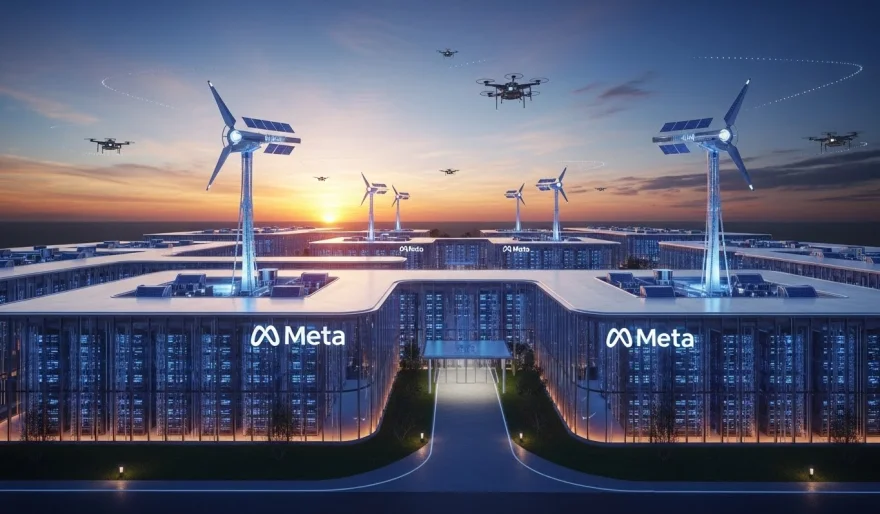
Mark Zuckerberg has announced Meta Compute, a new initiative focused on massively expanding the company’s AI infrastructure — from data centers and custom silicon to energy supply and long-term capacity planning. It’s the clearest signal yet that Meta sees infrastructure, not just models, as a core competitive advantage in AI.
Zuckerberg said Meta plans to build tens of gigawatts of capacity this decade, scaling to hundreds of gigawatts over time — an extraordinary figure that underscores just how energy-hungry large-scale AI has become. For context, some estimates suggest U.S. AI-related power demand could jump from around 5 gigawatts today to 50 gigawatts within a decade.
This move builds on what Meta hinted at last year, when CFO Susan Li said that “developing leading AI infrastructure” would be central to delivering better AI models and product experiences. Now, that strategy has a name — and a leadership structure.
Who’s running Meta Compute
Zuckerberg outlined three key executives driving the effort:
-
Santosh Janardhan, Meta’s head of global infrastructure, will oversee the technical backbone — including data center architecture, AI software stacks, Meta’s silicon program, and the operation of its global data center and network footprint.
-
Daniel Gross, co-founder of Safe Superintelligence alongside former OpenAI chief scientist Ilya Sutskever, will lead a new internal group focused on long-term capacity strategy, supplier relationships, industry analysis, and infrastructure business modeling.
-
Dina Powell McCormick, Meta’s president and vice chairman, will handle government relationships, financing, and public-private partnerships needed to build and deploy AI infrastructure at this scale.
Why this matters
This isn’t just a Meta story — it’s an industry shift.
AI is becoming an infrastructure war.
The biggest AI players are no longer content to rely solely on cloud providers or shared capacity. Like Alphabet, Microsoft, and Amazon, Meta is betting that owning compute, power, and silicon will define who wins the next phase of AI.
Energy is now a bottleneck.
By openly talking about gigawatts, Meta is acknowledging a hard truth: the future of AI is constrained as much by electricity and data centers as by algorithms. Companies that can secure power, land, and government cooperation will move faster than those that can’t.
Vertical integration is the strategy.
Meta isn’t just training models — it wants control over the entire stack, from chips and servers to networks and energy. That could reduce long-term costs, improve performance, and give Meta more independence from external cloud providers.
The bigger picture
Meta Compute signals that AI’s next arms race won’t just be about who has the smartest model — it’ll be about who can build and sustain AI at planetary scale.
For startups, this raises the bar. For governments, it brings AI squarely into infrastructure and energy policy. And for the AI industry as a whole, it’s another reminder that the future of intelligence is being shaped as much by concrete, copper, and power grids as by code.
If AI is the new electricity, Meta just told the world it plans to own the power plants.


















 AI Agents