Stay Ahead of the Curve
Latest AI news, expert analysis, bold opinions, and key trends — delivered to your inbox.
Microsoft Launches $2.5B AI Deployment Company to Bring Enterprise AI to the Real World
4 min read Microsoft is investing $2.5 billion to launch Microsoft Frontier Company, a new business dedicated to helping enterprises successfully deploy AI at scale. July 02, 2026 15:25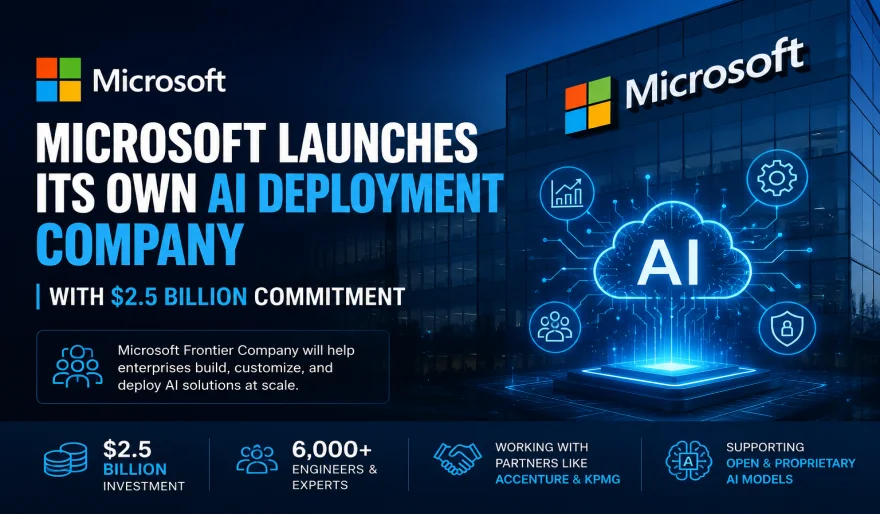
For the past two years, the AI race has been dominated by one question: Who has the best model?
Microsoft thinks the next battle is different.
Instead of building another frontier model, the tech giant is launching Microsoft Frontier Company—a new operating business backed by a $2.5 billion investment and a team of 6,000 engineers and industry experts focused on helping companies actually implement AI inside their organizations.
The move reflects a growing reality across enterprise AI. Most businesses aren't struggling to find AI models—they're struggling to figure out which models to use, how to integrate them into existing workflows, and how to generate measurable business value.
Unlike traditional consulting, Microsoft says Frontier Company will embed engineering teams directly with customers to build, customize, and deploy AI systems tailored to their needs. It also plans to work with partners like Accenture and KPMG while supporting a mix of proprietary and open-source models rather than locking customers into a single AI provider.
The announcement also signals Microsoft's evolving AI strategy. While the company remains one of OpenAI's biggest backers, it's increasingly positioning itself as the platform where businesses can choose whichever AI models work best—from OpenAI to open-source alternatives—rather than relying on a single ecosystem.
Why it matters
Enterprise AI is entering a new phase. Winning won't just depend on building the smartest model—it will depend on helping businesses successfully deploy AI across every department.
Microsoft is betting that implementation, not just innovation, will define the next trillion-dollar opportunity.
The upside
- Helps enterprises move from AI pilots to production.
- Gives customers flexibility to mix and match AI models.
- Creates a large engineering organization focused on real business outcomes rather than demos.
The downside
Deploying thousands of engineers is expensive, and Microsoft is entering an increasingly competitive market where firms like Palantir, AWS, and major consulting companies are also racing to become the go-to partners for enterprise AI adoption.
The takeaway
The AI race is no longer just about building bigger models. It's becoming a race to help businesses turn AI into measurable results—and Microsoft just committed $2.5 billion to make sure it's leading that next chapter.















 AI Agents