Stay Ahead of the Curve
Latest AI news, expert analysis, bold opinions, and key trends — delivered to your inbox.
Microsoft Taps Anthropic for Copilot Cowork as Tech Giants Race to Build AI Agents
8 min read Microsoft is expanding its AI strategy by bringing models from Anthropic into a new workplace tool called Copilot Cowork, marking another step in the tech industry’s push toward autonomous AI agents that can perform real tasks rather than simply answer questions. March 09, 2026 13:29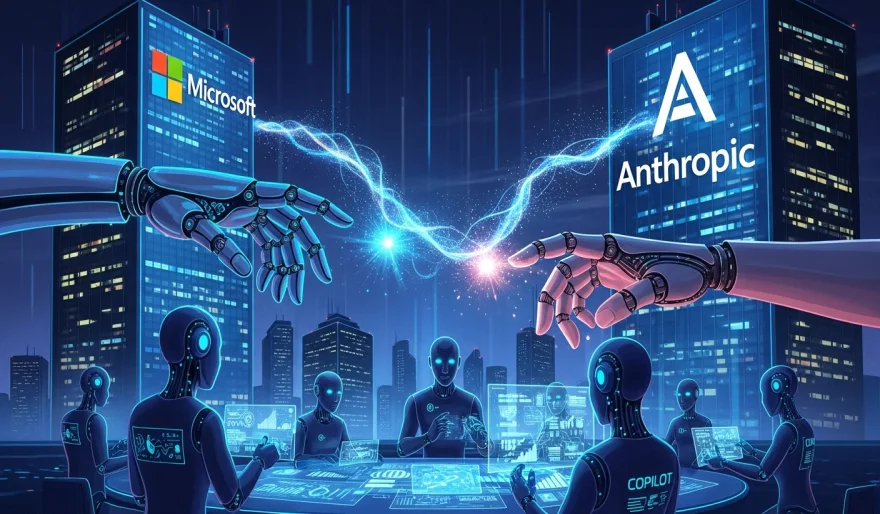
For the past two years, enterprise AI has largely centered around chat-based assistants — tools designed to draft emails, summarize documents, or answer questions.
But Copilot Cowork signals a shift in how workplace AI is being designed.
Instead of functioning solely as a conversational assistant, the tool is intended to act more like a digital collaborator, capable of completing tasks across the Microsoft ecosystem. That could include compiling reports, generating spreadsheets, organizing datasets, or assembling presentations based on enterprise data.
The concept reflects a broader trend across the industry: transforming AI from a tool employees use into something closer to a system that can carry out work on their behalf.
Why Microsoft Is Bringing Anthropic Into Copilot
The partnership may appear unexpected given Microsoft’s deep ties to OpenAI, whose models currently power much of the Microsoft Copilot ecosystem.
But integrating Anthropic’s models suggests Microsoft is moving toward a multi-model AI platform.
Anthropic’s flagship model family, Claude, is known for strong reasoning capabilities and enterprise-oriented safety features. By incorporating Claude alongside OpenAI models, Microsoft gains the flexibility to route different tasks to whichever system performs best.
In practical terms, Copilot could increasingly operate like an AI orchestration layer, selecting the right model depending on the job.
This approach mirrors how cloud infrastructure evolved — from relying on a single system to running multiple specialized engines within one platform.
The Industry’s New Battleground: AI Agents
The Copilot Cowork announcement arrives amid a growing race among major AI developers to build autonomous agents.
Companies including Google, OpenAI, and Anthropic are investing heavily in systems that can plan, reason through tasks, and execute actions across applications.
Unlike earlier AI tools that required constant prompts from users, agents are designed to carry out sequences of tasks independently, from analyzing data to updating documents or coordinating workflows.
For enterprise software providers, the opportunity is significant: AI agents could become embedded across everyday work tools — from messaging platforms to spreadsheets — potentially automating large portions of knowledge work.
Microsoft’s Strategic Position
Few companies are better positioned to deploy such systems at scale than Microsoft.
Through products like:
-
Microsoft Word
-
Microsoft Excel
-
Microsoft Outlook
-
Microsoft Teams
the company already sits at the center of daily corporate workflows.
Embedding AI agents directly into these tools allows Microsoft to distribute advanced automation without requiring companies to adopt entirely new software platforms.
In effect, Copilot becomes less of a feature and more of an AI layer across the Microsoft productivity stack.
The Enterprise Challenge: Trust and Control
Despite the rapid development of AI agents, enterprise adoption remains cautious.
Companies are concerned about issues such as:
-
Data access permissions
-
Security of internal documents
-
Compliance with regulatory standards
Microsoft’s strategy is to run Copilot within its enterprise cloud environment — primarily through Microsoft Azure — ensuring that AI systems operate within the same security and governance frameworks organizations already use.
For large companies, these assurances may prove more decisive than raw AI performance.
A Broader Shift in the AI Economy
Underlying the Copilot Cowork initiative is a larger transformation in how AI products are positioned.
The first generation of AI services largely focused on generating content — text, images, and code — in response to prompts.
The next generation is focused on completing work.
Rather than selling access to AI models alone, technology companies are increasingly packaging AI into systems capable of performing tasks across business workflows.
In that sense, the race is no longer just about building the most advanced model.
It is about building the platform through which AI becomes part of everyday work.
The Bottom Line
Microsoft’s decision to integrate Anthropic’s models into Copilot underscores how rapidly the enterprise AI landscape is evolving.
The development reflects three key shifts:
-
AI assistants are evolving into task-performing agents
-
Major platforms are adopting multi-model AI strategies
-
The competitive focus is moving from chat interfaces to workplace automation
If these systems deliver on their promise, the next phase of AI may not simply help employees write emails or summarize documents.
It may fundamentally reshape how digital work itself gets done.










 AI Agents