Stay Ahead of the Curve
Latest AI news, expert analysis, bold opinions, and key trends — delivered to your inbox.
Musk says Tesla's mega AI chip fab project to launch in seven days
7 min read Tesla CEO Elon Musk announced that the company’s Terafab project, a massive AI chip fabrication initiative, is set to launch in seven days. The fab aims to produce custom AI chips at scale, supporting Tesla’s autonomous driving, robotics, and AI infrastructure ambitions. March 16, 2026 14:36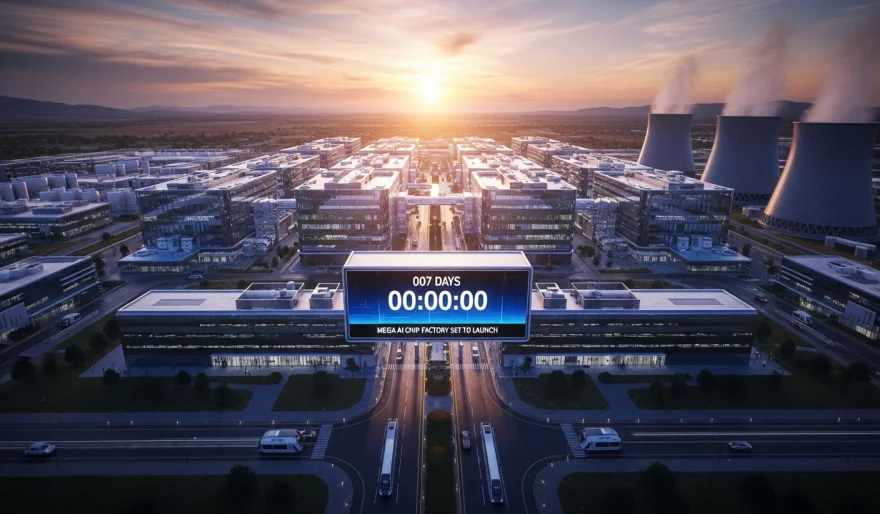
Tesla CEO Elon Musk has stunned the tech and semiconductor world by announcing that his company will kick off its Terafab project — a mega‑scale fabrication initiative to produce artificial intelligence chips — within the next seven days. The announcement sent ripples across markets and industry circles as Tesla positions itself not just as an EV maker, but as a serious contender in AI hardware manufacturing.
Unlike traditional chip strategies that rely almost entirely on external manufacturers like Taiwan Semiconductor Manufacturing Company (TSMC) or Samsung Electronics, Tesla aims to build its own large‑scale semiconductor fabrication facility — potentially one of the most ambitious in the industry. Musk’s argument is stark: to meet its future AI and autonomous driving demands, Tesla cannot rely on existing supply chains alone.
⚙️ What “Terafab” Is — And What It Isn’t (… Yet)
At a high level, the Terafab project is Tesla’s answer to the growing compute bottleneck that Big Tech companies face. AI systems — from large language models to autonomous driving stacks — require unprecedented quantities of custom silicon: logic chips, memory, and specialized packaging. Current fabs, even those run by TSMC and Samsung, are tightly booked for years, with lead times stretching out as companies scramble to train and deploy frontier models.
Musk has hinted that Terafab will be larger than any existing Gigafactory, potentially capable of producing hundreds of billions of chips per year — an output target that, if realized, would rival global leaders in semiconductor manufacturing capacity.
However, there’s an important nuance: when Musk says the project will launch in seven days, industry experts interpret this not as full chip production starting within a week, but rather the formal kickoff of the project — likely including announcements, initial planning, and perhaps groundbreaking. Building and equipping a full semiconductor fab typically takes multiple years, even for the most experienced players.
🔍 Why This Matters to the AI Ecosystem
For AI practitioners and infrastructure planners, the Terafab announcement touches on some of the most critical trends in the field:
1. The AI hardware bottleneck is real — and getting political.
AI compute isn’t just software — it’s fundamentally bounded by silicon. Nvidia’s dominance in GPUs has made its chips the de-facto choice for training and inference, leading to supply constraints. Tesla’s move signals that ambitious AI developers are willing to vertically integrate hardware production to secure supply, reduce costs, and tailor silicon to specific workloads.
2. In‑house silicon could unlock performance gains.
Tesla’s past efforts — including its Dojo supercomputer and custom AI5 chip — illustrate a long‑term strategy of building differentiated silicon tuned to its own workloads. A dedicated fab, if successful, could accelerate iterations not just for automotive AI (Full Self‑Driving), but for robotics (Optimus), data centers, and potentially third‑party AI workloads.
3. Terafab raises strategic questions for global AI supply chains.
Most cutting‑edge fabs are concentrated in East Asia, especially Taiwan. A large, U.S.‑based AI chip fab could have geopolitical implications, aligning with government incentives to onshore semiconductor production. It also introduces a new competitor in a field historically led by Intel, TSMC, and Samsung.
4. Execution risk is high — but so are the potential rewards.
Building a fab is one of the most capital‑intensive, technically demanding undertakings in modern industry. Experts note that even once launched, meaningful volume production could be years away. That said, the strategic upside — stable supply, bespoke silicon, and control over the compute stack — could be a game‑changer if Tesla pulls it off.
🧠 What to Watch Next
-
Detailed announcements: Over the next week, Tesla is likely to reveal more about the Terafab’s location, partners, and investment size.
-
Partnerships and tech stack: Talks with Intel and others could shape the fab’s architecture and production roadmap.
-
Impact on Tesla’s AI hardware roadmap: How Terafab integrates with AI5, AI6, and future custom chips will be key.
-
Market reaction: Investors are watching whether this signals a broader strategic shift from Tesla toward AI infrastructure revenue streams.
In an era where compute often dictates competitive advantage in AI, Musk’s Terafab project might be one of the most audacious bets yet — transforming Tesla from a consumer tech company into a hardware‑driven AI infrastructure player.



















 AI Agents