Stay Ahead of the Curve
Latest AI news, expert analysis, bold opinions, and key trends — delivered to your inbox.
OpenAI Launches Prism
4 min read OpenAI launched Prism, a free AI workspace for scientists that integrates GPT-5.2 to help draft papers, check claims, and search literature. It works as an AI co-author and research assistant, speeding up writing and review while leaving scientific judgment to humans. January 28, 2026 11:41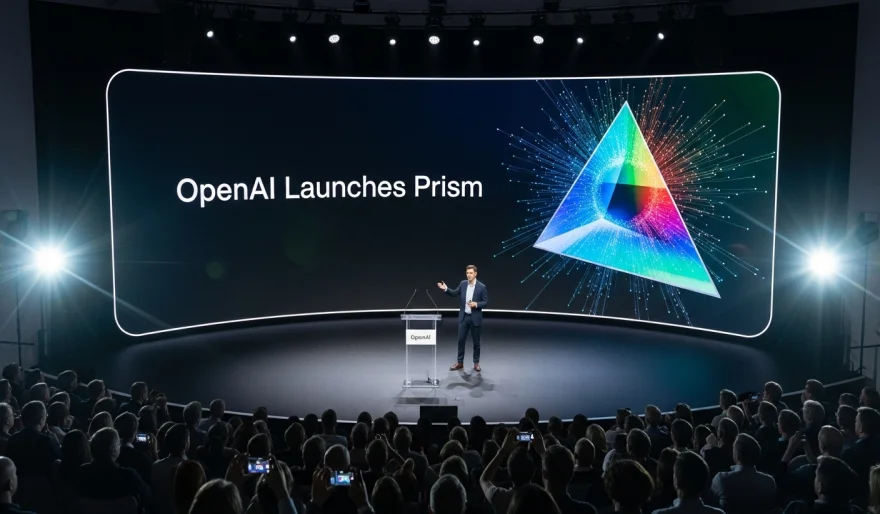
OpenAI has unveiled Prism, a new AI-powered scientific workspace available for free to anyone with a ChatGPT account.
Think of Prism as an AI-enhanced word processor for science. It’s designed to help researchers draft papers, assess claims, refine language, and search existing literature — all inside a single workspace powered by GPT-5.2.
How Prism Works
-
Writing & Revision: Prism can revise prose, improve clarity, and ensure scientific tone, much like an AI co-author.
-
Claim Assessment: Researchers can submit statements or findings, and Prism cross-checks them against existing knowledge or suggests references.
-
Literature Search: It can scan prior research and highlight relevant papers, helping users quickly contextualize their work.
-
Integrated Workflow: All features are accessible within a single interface, letting scientists draft, edit, and fact-check without switching tools.
Importantly, Prism doesn’t generate original research on its own. It accelerates the human parts of research — drafting, reviewing, and navigating prior work — while leaving the scientific judgment to the researcher. OpenAI compares Prism to coding interfaces like Cursor and Windsurf, but designed for research instead of programming.
Why this matters
Scientific progress is often bottlenecked not by ideas, but by communication — drafting papers, revising arguments, validating claims, and navigating prior work. Prism targets that friction directly.
By embedding GPT-5.2 into the research workflow, OpenAI is trying to make AI feel less like a chatbot and more like invisible infrastructure for knowledge work.
The bigger picture
-
Prism reinforces a trend: vertical AI tools built for specific professions.
-
OpenAI is expanding beyond consumer chat into serious work environments.
-
Free access lowers the barrier for early-career researchers, independent scientists, and students.
It also positions ChatGPT as a default environment for academic writing — a space traditionally dominated by Word, Google Docs, and LaTeX editors.
The trade-off
Pros
-
Faster drafting and revision cycles
-
Easier claim-checking and literature context
-
Lower friction for publishing-quality writing
Cons
-
Risk of over-polished but shallow papers
-
New questions around authorship and originality
-
Potential homogenization of scientific writing styles
The takeaway
Prism isn’t about replacing scientists — it’s about compressing the distance between thinking and publishing.
Hot take: The labs that win in the next decade won’t just have better data — they’ll have better AI-assisted writing and review workflows.









 AI Agents