Stay Ahead of the Curve
Latest AI news, expert analysis, bold opinions, and key trends — delivered to your inbox.
Pentagon–Anthropic Clash Puts AI Defense Contracts and Warfare Strategy on the Line
4 min read A growing dispute between the U.S. Department of Defense and Anthropic is nearing a critical deadline, with billions in potential defense AI contracts at stake. The disagreement centers on model access, deployment standards, and how Anthropic’s frontier systems can be used in military environments. February 27, 2026 16:26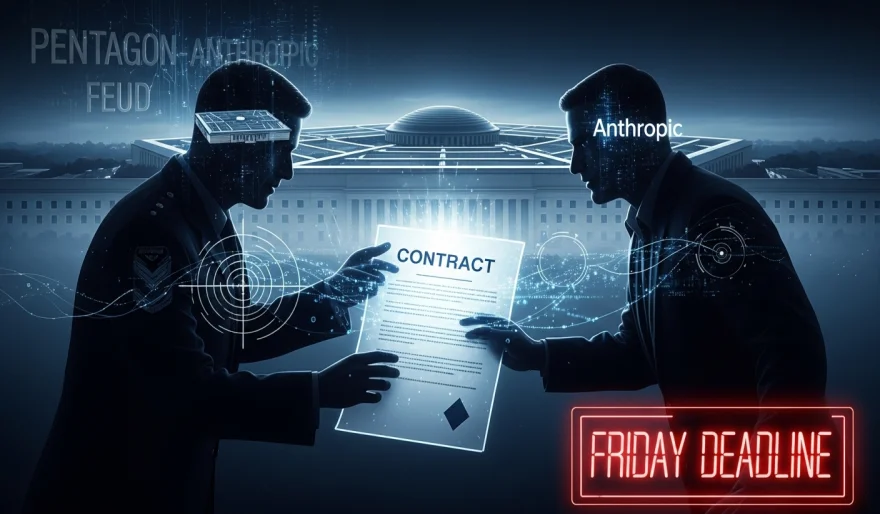
A high-stakes standoff is brewing between the U.S. Department of Defense and Anthropic — and it’s about more than paperwork.
At the center: access, compliance, and control over how frontier AI models are deployed inside defense systems. With a Friday deadline looming, both sides face a decision that could shape who powers the next generation of U.S. military AI.
What’s Really at Stake?
This isn’t just a procurement dispute. It’s about:
-
Model access for classified environments
-
Deployment standards for military AI
-
Sales positioning in a fast-growing defense AI market
-
Rules around safety, transparency, and oversight
The Pentagon wants deeper integration and clearer guarantees around model behavior in mission-critical systems. Anthropic, known for its safety-first branding, reportedly wants stricter guardrails around how its models are used — especially in autonomous or kinetic contexts.
In other words: how far should commercial AI go in warfare?
Why This Matters Now
The Department of Defense has accelerated AI adoption under programs aimed at battlefield decision-making, logistics optimization, intelligence analysis, and autonomous systems. Contracts tied to these programs can run into the billions.
If Anthropic walks away — or is sidelined — rivals like OpenAI, Google, or Palantir could deepen their defense footprint.
But if Anthropic complies fully, it risks brand tension. The company has consistently positioned itself as the “AI safety company.” Military alignment complicates that narrative.
The Bigger Picture: AI Labs vs. Defense Doctrine
We’re entering a new phase where frontier AI companies are no longer just Silicon Valley players — they’re strategic infrastructure partners.
The Pentagon wants:
-
Reliable, controllable, auditable models
-
Long-term deployment rights
-
Operational flexibility
AI labs want:
-
Clear boundaries
-
Limited liability
-
Brand protection
-
Controlled model behavior
That friction is inevitable.
The Real Question
Will AI companies become full-spectrum defense contractors — or will they draw a hard line?
This Friday’s deadline could clarify how much leverage AI labs truly have when national security contracts are on the table.
Because once models move from chat interfaces to command centers, the stakes stop being theoretical.



















 AI Agents