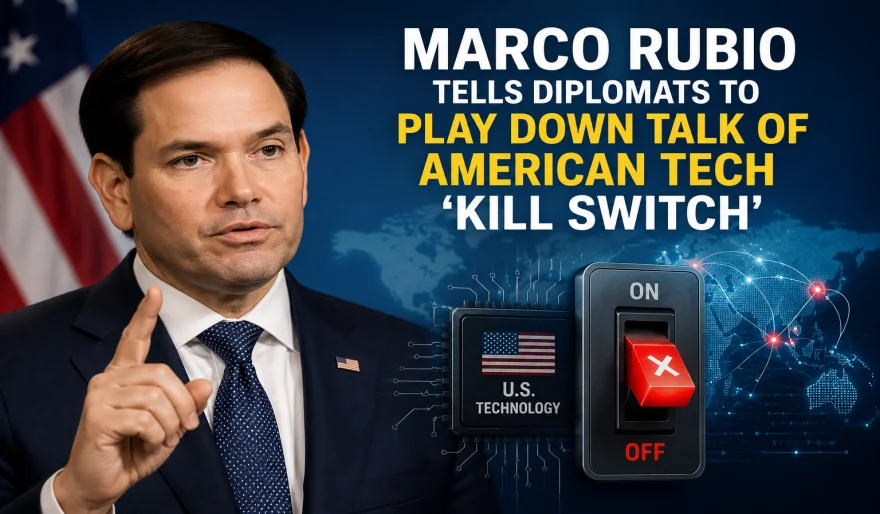
Rubio Urges U.S. Diplomats to Downplay Fears of an American Tech 'Kill Switch'
5 min readU.S. Secretary of State Marco Rubio has instructed American diplomats to push back against growing international concerns that U.S.-made technology could contain a hidden "kill switch" allowing Washington to remotely disable critical systems. The move comes as geopolitical tensions increasingly shape the global AI and technology race.July 22, 2026 14:33
As competition over AI and advanced technology intensifies, the United States is trying to reassure allies that American technology can be trusted.
According to reports, Secretary of State Marco Rubio has directed U.S. diplomats to downplay claims that American-made hardware, software, and AI systems include a secret "kill switch" that would allow the U.S. government to remotely disable products sold abroad during times of conflict or political disputes.
The concern has gained traction in recent years as countries become more dependent on foreign technology for everything from cloud computing and AI infrastructure to semiconductors and telecommunications. Some governments fear that relying heavily on U.S. technology could leave them vulnerable if diplomatic relations deteriorate.
The State Department's message is aimed at reassuring partner nations that American technology companies remain reliable suppliers and that concerns over hidden remote shutdown capabilities are being exaggerated.
The issue extends beyond traditional technology. As AI models, cloud platforms, and advanced chips become essential national infrastructure, trust is becoming just as important as innovation. Governments are increasingly asking not only who builds the technology but also who ultimately controls it.
The debate also reflects a broader shift in global technology policy. Countries are investing heavily in domestic AI models, semiconductor manufacturing, and sovereign cloud infrastructure to reduce dependence on foreign providers.
Why it matters
The AI race is no longer just about building the most powerful models—it's also about trust. If countries believe foreign technology could be remotely controlled, they may accelerate efforts to build domestic alternatives, reshaping global technology markets.
The upside
Could reassure allies and strengthen confidence in U.S. technology exports.
May help preserve international demand for American AI, cloud, and semiconductor companies.
Reinforces the importance of transparency in global technology partnerships.
The downside
Existing concerns over technological dependence are unlikely to disappear quickly.
More countries may continue investing in sovereign AI infrastructure regardless of U.S. assurances.
The issue could deepen geopolitical competition between U.S., Chinese, and regional technology ecosystems.
Looking ahead
As AI becomes critical national infrastructure, countries will increasingly evaluate technology not only on performance and price but also on security, control, and geopolitical risk. The "kill switch" debate highlights how trust is becoming one of the most valuable assets in the global AI economy.
Comments will not be approved to be posted if they are SPAM, abusive, off-topic, use profanity, contain a personal attack, or promote hate of any kind.