Stay Ahead of the Curve
Latest AI news, expert analysis, bold opinions, and key trends — delivered to your inbox.
Samsung Reportedly Plans $648 Billion Investment as AI Redraws South Korea's Economy
4 min read Samsung is reportedly preparing a massive 900 trillion won ($648 billion) investment plan, underscoring how the AI boom is reshaping South Korea's industrial strategy and intensifying the global race for AI leadership. June 26, 2026 14:03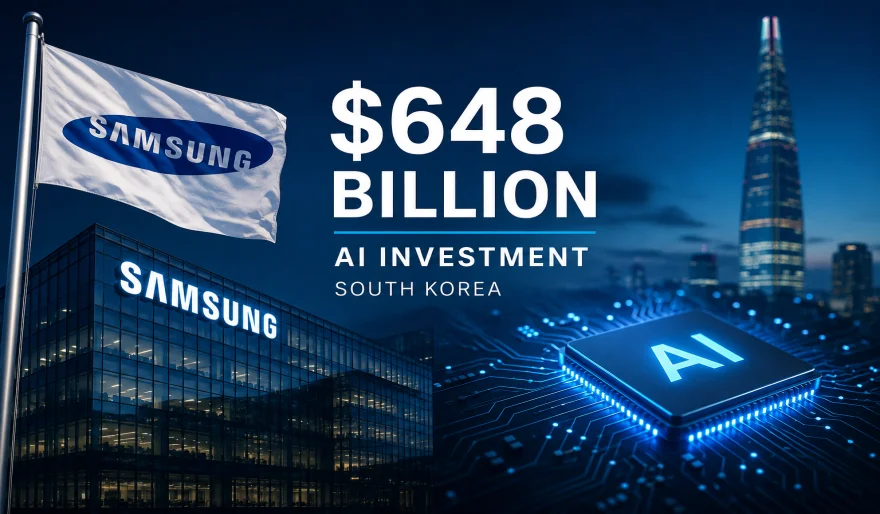
The artificial intelligence boom is no longer just about who builds the smartest chatbot. Increasingly, it's about who owns the infrastructure powering the next generation of computing.
That's the backdrop to reports that Samsung is preparing an extraordinary 900 trillion won ($648 billion) investment spanning semiconductors, AI infrastructure, robotics, advanced manufacturing, and future technologies. If approved, it would rank among the largest long-term corporate investment plans ever announced.
The timing is no coincidence. Demand for AI chips has exploded over the past two years, creating fierce competition among technology companies and governments to secure the manufacturing capacity needed for the next wave of AI systems. While companies like Nvidia have captured much of the spotlight with their GPUs, Samsung sits much deeper in the supply chain. It produces high-bandwidth memory (HBM), one of the most critical components inside today's AI servers, while also expanding its foundry business to manufacture chips for other companies.
The investment also reflects a broader shift taking place inside South Korea. AI is no longer viewed simply as another growth industry—it is increasingly becoming part of the country's industrial strategy. As the United States and China pour hundreds of billions into AI infrastructure, South Korea appears determined to ensure one of its biggest technology champions remains globally competitive.
Why this matters
This is bigger than Samsung.
The AI race is entering a new phase where computing infrastructure—not just better models—will determine who leads the industry. Companies that control semiconductor manufacturing, memory production, and AI data center capacity will have enormous influence over how quickly AI can advance.
Samsung's reported investment suggests it wants to become one of those companies.
The upside
A spending plan of this scale could strengthen global AI supply chains, accelerate chip production, reduce bottlenecks that have slowed AI development, and create thousands of high-skilled jobs. It could also help Samsung regain momentum in areas where competitors have recently taken the lead, particularly AI memory and advanced chip manufacturing.
The downside
Massive investments don't guarantee success. Samsung still faces intense competition from Nvidia in AI hardware, TSMC in chip manufacturing, and increasingly aggressive Chinese semiconductor companies. The investment also comes at a time when geopolitical tensions, export restrictions, and slowing global demand could make returns less predictable.
Even so, the direction is becoming unmistakable. The companies shaping the future of AI won't just be the ones building the most capable models—they'll be the ones building the infrastructure the entire industry depends on.


















 AI Agents