Stay Ahead of the Curve
Latest AI news, expert analysis, bold opinions, and key trends — delivered to your inbox.
Sarvam Brings Offline AI to Feature Phones, Cars, and Smart Glasses
4 min read Sarvam plans to deploy lightweight, edge-based AI models on Nokia feature phones, vehicles, and smart glasses, aiming to deliver offline, local-language AI at massive scale. Announced at the India AI Impact Summit, the move highlights India’s push toward sovereign, on-device AI built for real-world connectivity and hardware constraints. February 18, 2026 14:59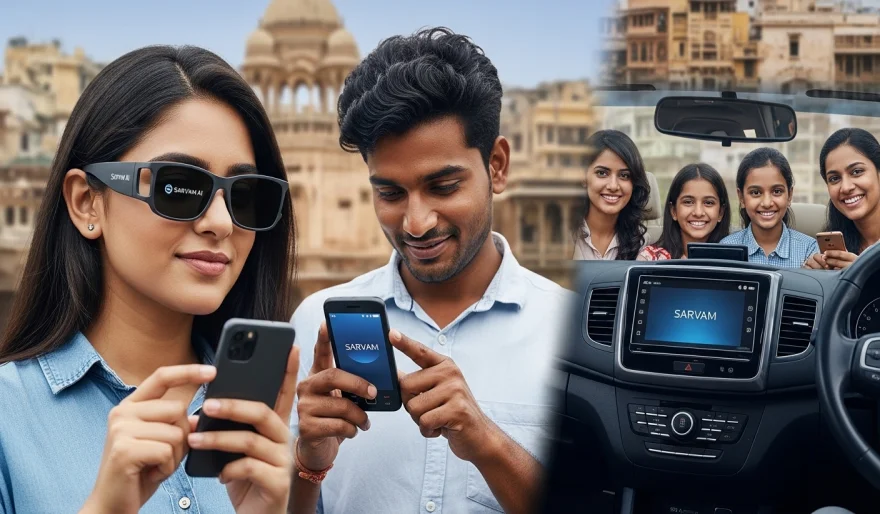
India’s AI push is going offline — and going mass market.
Sarvam says it plans to deploy its newly released AI models across feature phones, cars, and smart glasses, using ultra-lightweight edge models that can run on everyday hardware and, in many cases, without an internet connection.
The announcement was made at the India AI Impact Summit in New Delhi — and it signals a very different vision of AI adoption.
AI built for the real world
Sarvam’s models are designed to be:
-
Only megabytes in size
-
Capable of running on existing processors
-
Optimized for offline and edge use
-
Focused on local languages and real utility
Instead of chasing cloud-scale models, Sarvam is betting on distribution at population scale.
Feature phones are the first frontier
In partnership with HMD, Sarvam is bringing a conversational AI assistant to Nokia feature phones.
A demo showed users pressing a dedicated AI button to speak with an assistant in a local language — asking about government schemes, local markets, and everyday information.
That’s not a Silicon Valley use case.
That’s India-scale AI.
Beyond phones: cars, glasses, and more
Sarvam also revealed it has worked closely with Qualcomm to tune its models for Qualcomm chipsets, paving the way for deployment across:
-
Cars
-
PCs and laptops
-
Smart glasses
-
IoT devices
Qualcomm says it’s building a “Sovereign AI Experience Suite” to support exactly this kind of cross-device, on-device intelligence.
Why this matters
Most AI today assumes:
-
Constant internet
-
Cloud access
-
Expensive devices
Sarvam is flipping that assumption.
By pushing AI to the edge, the company is targeting markets where connectivity is unreliable, devices are basic, and language diversity is non-negotiable.
As Sarvam’s Head of Edge AI Tushar Goswamy put it: the goal is intelligence on every phone, car, and new category of device.
The bigger signal
This is also about sovereignty.
Sarvam’s CEO Vivek Raghwan says edge deployment helps keep data local and move sovereign AI from research into real-world adoption — at scale.
Hot take
The next billion AI users won’t meet AI through chatbots on laptops.
They’ll meet it through buttons on feature phones, dashboards in cars, and devices that work offline.
Sarvam isn’t building the smartest AI.
It’s building the most reachable one.


















 AI Agents