Stay Ahead of the Curve
Latest AI news, expert analysis, bold opinions, and key trends — delivered to your inbox.
Tesla Just Put Fully Driverless Robotaxis on Austin Streets
5 min read Tesla has begun paid, fully driverless robotaxi rides in Austin, with no human safety driver onboard. It’s a faster, riskier approach than rivals like Waymo — and a real-world test of whether vision-based AI is finally ready for autonomy at scale. January 23, 2026 12:54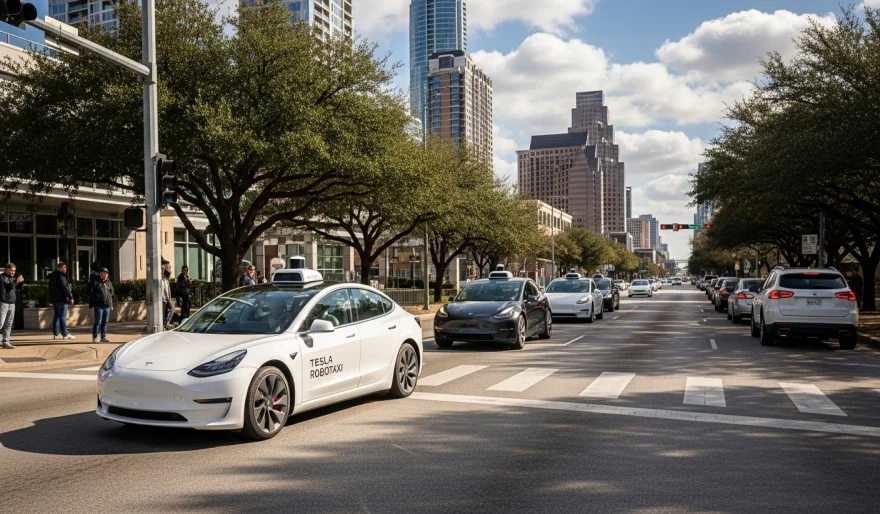
Elon Musk announced that Tesla has begun robotaxi rides in Austin with no human safety driver inside the car. No one in the front seat. No human fallback. Just software, sensors, and confidence.
“Just started Tesla Robotaxi drives in Austin with no safety monitor in the car,” Musk posted on X, praising the Tesla AI team and using the moment to recruit engineers to work on what he claims could “likely lead to AGI.”
This is a major escalation from Tesla’s earlier approach. When robotaxis first launched in Austin last June, rides were limited, invite-only, and included a safety operator in the passenger seat. By December, Tesla began testing unsupervised vehicles quietly. Now, those tests have turned into paid public rides.
Not every vehicle is fully autonomous yet. Tesla’s AI lead Ashok Elluswamy says the rollout will start small: a few unsupervised vehicles mixed into a larger fleet that still includes safety monitors. Over time, that ratio will increase.
Some riders have already confirmed they’re being charged. There’s also a visible “chase car” trailing the driverless vehicles — a reminder that while the driver is gone, oversight isn’t completely hands-off.
Why this matters
This isn’t just another Tesla demo. It’s a real-world bet.
Waymo and Zoox took a slower, more conservative path — years of testing, geo-fenced areas, and free rides at launch. Tesla is doing the opposite: scaling faster, charging sooner, and relying heavily on vision-based AI instead of expensive lidar-heavy systems.
If this works, Tesla doesn’t just win robotaxis — it rewrites the cost structure of autonomy.
If it doesn’t, the risks are public, visible, and immediate.
The bigger picture for AI and autonomy
Tesla’s approach is a stress test for modern AI:
-
Can end-to-end neural networks handle messy, unpredictable city driving?
-
Can software trained largely on real-world fleet data outperform tightly constrained autonomous stacks?
-
And crucially: how much autonomy is “good enough” before regulators step in?
Musk framing this as a path toward AGI isn’t accidental. Tesla is positioning real-world driving as one of the hardest applied AI problems — and Austin is now part of that experiment.
Pros and cons of Tesla’s move
Pros
-
🚀 Faster path to scalable robotaxi economics
-
💸 Early monetization instead of years of free pilots
-
🧠 Massive real-world data advantage from live deployments
-
🏎️ Pressure on competitors to move faster
Cons
-
⚠️ Higher public risk if something goes wrong
-
🧾 Regulatory scrutiny could intensify quickly
-
👀 Chase cars signal autonomy still isn’t fully trusted
-
🧪 Fewer guardrails than rivals like Waymo
The quiet signal
Charging for rides changes everything.
Once money exchanges hands, this stops being a demo and starts being a transportation service. That raises the bar — legally, ethically, and technically.
Austin is now Tesla’s proving ground. Whether this becomes the blueprint for robotaxis everywhere or a cautionary tale depends on what happens next — and how often humans still need to intervene, even when they’re not in the car.













 AI Agents