Stay Ahead of the Curve
Latest AI news, expert analysis, bold opinions, and key trends — delivered to your inbox.
Tesla quietly revives Dojo — but this time, it’s heading to space
6 min read Elon Musk says Tesla is reviving Dojo3 — but not for cars. This time, it’s aimed at space-based AI compute. After shutting Dojo down months ago and leaning on Nvidia, Tesla is back to custom chips with AI7. High-risk moonshot, big implications January 21, 2026 13:35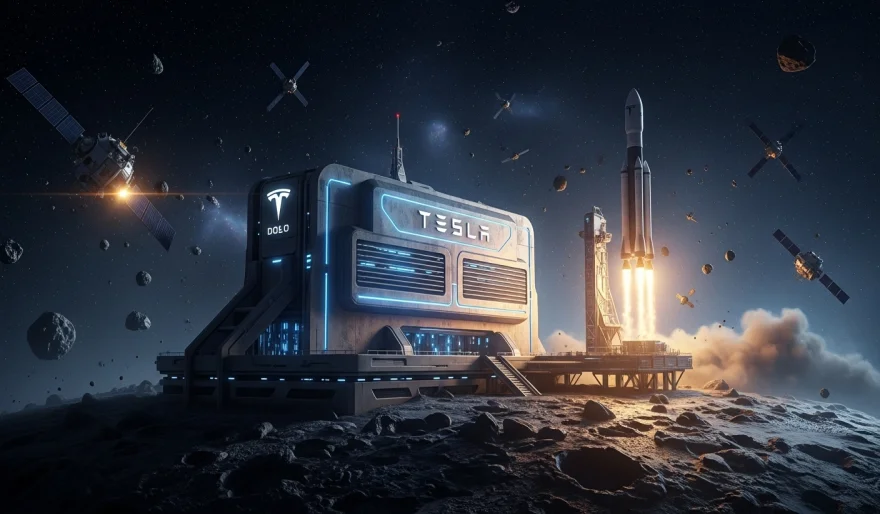
Just months after Tesla appeared to abandon its in-house AI supercomputer ambitions, Elon Musk is back with a plot twist.
Over the weekend, Musk said Tesla is reviving Dojo3, its previously shelved third-generation AI chip project — not for self-driving cars on Earth, but for what he calls “space-based AI compute.”
Yes, space.
A quick rewind
Earlier this year, Tesla effectively shut down its Dojo effort. The Dojo supercomputer team was disbanded following the departure of its lead, Peter Bannon, and around 20 engineers left to form or join DensityAI, a new AI infrastructure startup founded by ex-Tesla Dojo leadership.
At the time, the narrative was clear:
Tesla would lean harder on Nvidia, AMD, Samsung, and other partners instead of building custom silicon in-house. Bloomberg even reported Dojo was no longer central to Tesla’s AI roadmap.
That story just changed — again.
Why Tesla changed its mind
According to Musk, the revival of Dojo is tied to progress elsewhere in Tesla’s chip pipeline. He said Tesla’s AI5 chip design is “in good shape,” giving the company room to take bigger risks.
-
AI5 (TSMC-built): Designed for Full Self-Driving and Optimus robots
-
AI6 (Samsung-built): Backed by a $16.5B deal, aimed at vehicles, robots, and data-center-scale training
-
AI7 / Dojo3: Now positioned as a moonshot for space-based AI compute
In Musk’s words:
“AI7/Dojo3 will be for space-based AI compute.”
That single line reframes Dojo from a struggling internal project into something far more ambitious — and speculative.
What “space-based AI compute” likely means
Musk didn’t elaborate, but reading between the lines:
-
AI compute outside Earth’s power and cooling constraints
-
Possible integration with Starlink, orbital data centers, or future space infrastructure
-
Long-term bets on AI autonomy, planetary-scale sensing, or defense-adjacent use cases
This isn’t about beating Nvidia on cost-per-token today. It’s about owning compute in environments where Nvidia can’t easily play.
Tesla is rehiring — publicly
In classic Musk fashion, the announcement doubled as a recruitment ad. He openly invited engineers to email Tesla directly, pitching Dojo as:
“What will be the highest volume chips in the world.”
That’s bold — especially for a project Tesla killed just months ago.
Why this matters
1. Tesla isn’t done building its own chips
Despite heavy reliance on Nvidia, Tesla clearly doesn’t want to be permanently dependent on external AI suppliers — especially as compute becomes a strategic bottleneck.
2. AI infrastructure is splitting into “Earth AI” and “beyond Earth” bets
Most AI companies are fighting over data centers, power grids, and GPUs. Musk is signaling that the next frontier for compute may not be terrestrial at all.
3. Dojo’s failure wasn’t technical — it was strategic
The pivot suggests Dojo wasn’t dead because it couldn’t work, but because it didn’t fit Tesla’s short-term priorities. Space gives it a longer runway and a bigger narrative.
Pros and Cons
Pros
-
Full vertical control over future AI compute
-
Differentiation from Nvidia-centric AI stacks
-
Strategic alignment with SpaceX and Starlink
-
Long-term hedge against compute scarcity on Earth
Cons
-
Extremely speculative and capital-intensive
-
Talent trust issues after the last Dojo shutdown
-
No clear commercial timeline
-
High risk of becoming a science project rather than a product
Big picture
This isn’t about self-driving anymore. It’s about where AI lives in the next decade.
While the rest of the industry is racing to build bigger data centers, Musk is asking a different question:
What if the future of AI compute doesn’t stay on Earth at all?

















 AI Agents