Stay Ahead of the Curve
Latest AI news, expert analysis, bold opinions, and key trends — delivered to your inbox.
TIDAL Draws a Line on AI Music—No Royalties for Artificial Tracks
4 min read TIDAL is tightening its stance on AI-generated music by cutting off monetization, signaling a broader industry push to protect artists and streaming royalties. June 29, 2026 16:58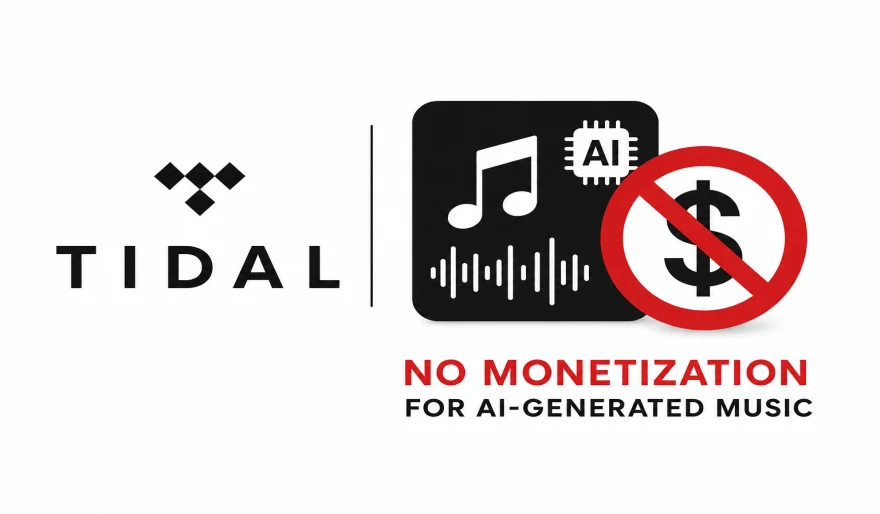
For years, streaming platforms have wrestled with a difficult question: What happens when millions of songs are created by machines instead of musicians?
TIDAL has made its answer a little clearer.
The music streaming service is introducing measures that prevent AI-generated tracks from earning royalties on its platform, a move designed to curb the growing flood of synthetic music that's increasingly competing with human artists for streams and payouts.
The decision comes as generative AI makes it possible to produce thousands of songs in minutes. While some creators use AI as a creative tool, others have exploited the technology to upload massive catalogs of low-effort tracks in hopes of collecting streaming revenue.
For TIDAL, the concern isn't just about authenticity—it's about economics. Every fraudulent or AI-generated stream can dilute royalty pools, reducing payouts for musicians who create original work.
The move also reflects a wider shift across the music industry. Labels, streaming services, and rights organizations are investing heavily in AI detection tools as they try to distinguish between music made with AI and music generated by AI for the sole purpose of gaming the system.
Rather than banning AI outright, platforms are increasingly targeting the financial incentives that encourage spam.
Why it matters
The debate around AI music is moving beyond copyright lawsuits. It's becoming a business problem. As AI-generated songs flood streaming platforms, companies are being forced to decide who deserves to get paid—and under what conditions.
The upside
- Human artists receive greater protection from AI-generated royalty farming.
- The move could discourage spam uploads designed solely to earn streaming revenue.
- It encourages more responsible use of AI as a creative tool rather than a replacement for artists.
The downside
- Defining what counts as "AI-generated" remains technically challenging.
- Legitimate musicians who use AI in their creative process could face uncertainty.
- Other streaming platforms may adopt different policies, creating inconsistency across the industry.
The takeaway
The music industry's AI debate is entering a new phase. Instead of asking whether AI-generated music belongs on streaming platforms, companies are beginning to ask a more consequential question: Should it get paid? TIDAL's latest move suggests that, for now, the answer is becoming far more selective.









 AI Agents