Stay Ahead of the Curve
Latest AI news, expert analysis, bold opinions, and key trends — delivered to your inbox.
TranslateGemma: Smaller Open Models, Better AI Translation
3 min read Google unveils TranslateGemma, a new open-source translation suite built on Gemma 3. The 12B model beats a 27B baseline on WMT24++, while the 4B rivals larger models—delivering faster, cheaper, high-quality translation across 55 languages. January 16, 2026 10:20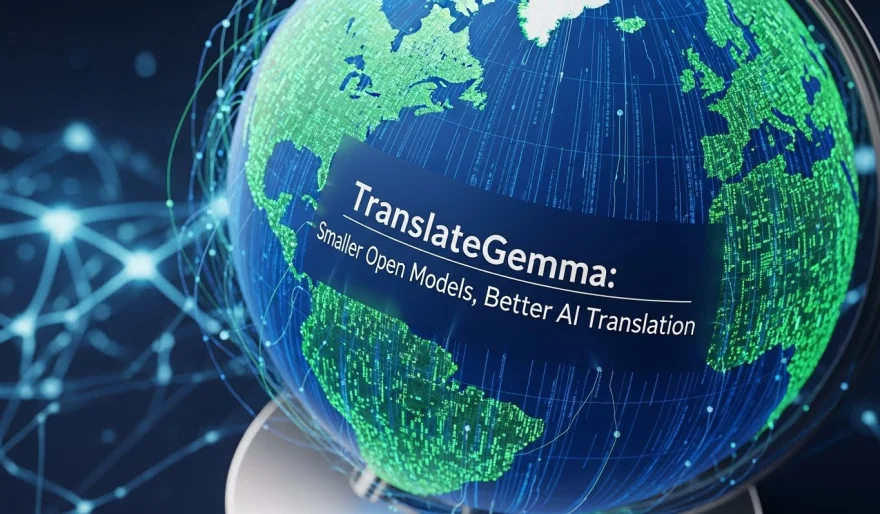
Google has introduced TranslateGemma, a new suite of open-source translation models built on Gemma 3, designed to deliver high-quality translation across 55 languages—without the heavy compute costs usually associated with large models.
Available in 4B, 12B, and 27B parameter sizes, TranslateGemma focuses on a key idea: efficiency without sacrificing quality. By distilling knowledge from Google’s most advanced large models, the team has produced compact models that perform at — and in some cases beyond — their larger counterparts.
Smaller models, better results
The standout result from Google’s technical evaluation is the 12B TranslateGemma model outperforming the larger Gemma 3 27B baseline on the WMT24++ benchmark, measured using MetricX. That’s a big deal in open translation, where performance has often scaled mainly with model size.
For developers, this means:
-
Lower latency and higher throughput
-
Reduced compute and deployment costs
-
High-fidelity translations without massive infrastructure
Even more impressive, the 4B model rivals the performance of the 12B baseline, making it a strong candidate for mobile and edge inference, where resources are limited.
Built for real-world language diversity
TranslateGemma was evaluated on WMT24++, covering 55 languages across high-, mid-, and low-resource categories. Across the board, the models significantly reduced error rates compared to baseline Gemma models, improving translation quality while remaining computationally efficient.
Why it matters
TranslateGemma signals a shift in open translation: progress is no longer just about bigger models, but smarter training and better distillation. For startups, researchers, and developers building global products, this lowers the barrier to deploying high-quality multilingual AI—on any device, anywhere.
The takeaway: open translation just got faster, lighter, and more accessible—without giving up accuracy.














 AI Agents