Stay Ahead of the Curve

Latest AI news, expert analysis, bold opinions, and key trends — delivered to your inbox.

Why Early GPU Investors Are Betting $400 Million on AI Inference Chips

4 min read Some of the earliest financiers behind the GPU boom are shifting their focus to AI inference chips, backing a new $400 million deal that reflects the next major opportunity in artificial intelligence. July 17, 2026 12:49 Why Early GPU Investors Are Betting $400 Million on AI Inference Chips
The AI hardware race is entering a new phase.

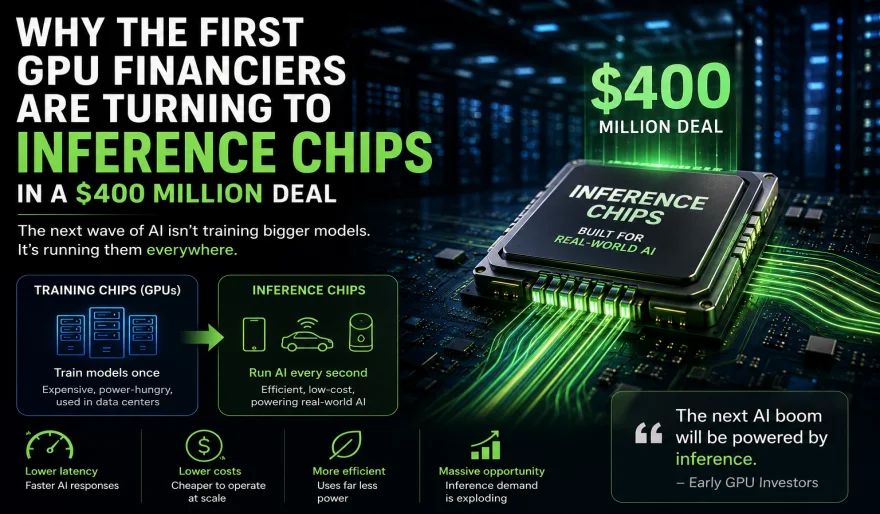
After years of pouring billions into GPUs used to train massive AI models, investors are now chasing a different prize: inference chips—the processors that power AI once it's deployed in the real world.

A new $400 million investment highlights this shift. The financiers who helped fuel the GPU infrastructure boom now believe inference hardware will become one of AI's fastest-growing markets as businesses move from training models to serving millions of users every day.

Unlike training, which happens occasionally on massive clusters, inference runs continuously whenever someone uses ChatGPT, generates an image, or interacts with an AI assistant. That constant demand is creating opportunities for startups building chips that deliver faster performance at lower cost and with significantly better energy efficiency than traditional GPUs.

As AI adoption spreads across enterprises and consumer apps, inference is expected to account for a growing share of computing demand, making specialized chips an increasingly attractive investment.

Why it matters

The AI industry is shifting from building bigger models to running them efficiently. That transition could reshape the semiconductor market and create a new generation of AI hardware leaders.

The upside

Inference chips promise lower operating costs, improved energy efficiency, and faster AI services, helping businesses deploy AI at much larger scale.

The downside

The market is becoming crowded, with startups competing against industry giants like NVIDIA, AMD, and hyperscale cloud providers that are building their own custom AI chips.

Bottom line: The next AI hardware boom may not belong to the companies training models—it could belong to the firms making AI cheaper and faster to use every day.

User Comments (0)

Add Comment
We'll never share your email with anyone else.

img