Stay Ahead of the Curve
Latest AI news, expert analysis, bold opinions, and key trends — delivered to your inbox.
Zuckerberg Releases Muse Glimmer
7 min read Meta has released Muse Glimmer, a 30B open-weight AI model designed to run locally on consumer devices, giving developers more privacy, lower costs, and greater control over their AI agents. August 10, 2026 16:12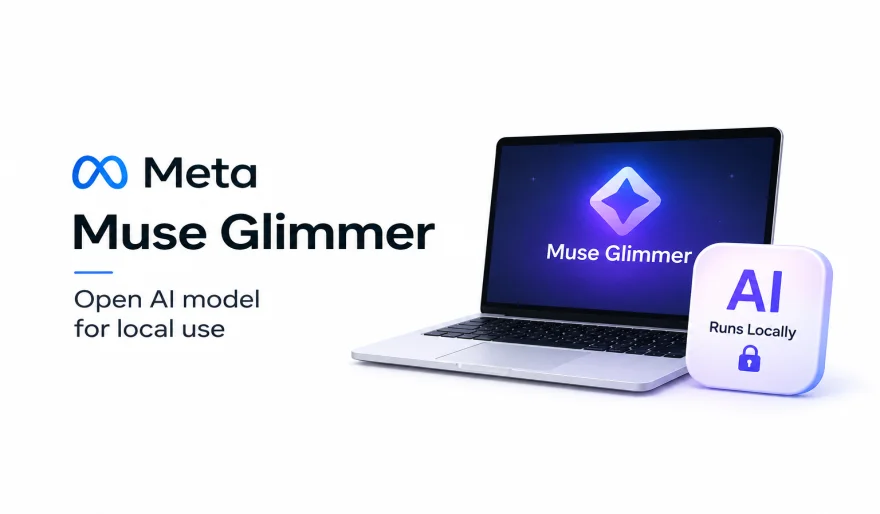
Meta is pushing AI away from the cloud with Muse Glimmer, a 30-billion-parameter open-weight model designed to run directly on consumer hardware.
Meta is making a major bet on a different future for AI: powerful models that live on your device instead of inside a data center.
The company’s Superintelligence Labs has released Muse Glimmer, a 30-billion-parameter model optimized for local, always-on AI agents. Its weights are available under the permissive Apache 2.0 license, meaning developers can download, modify and deploy the model on their own hardware.
And the hardware requirement is surprisingly modest.
Meta says the model can run on a Mac or PC with a single consumer GPU. Through quantization, the model is compressed from more than 55GB at full precision to under 20GB, allowing it to fit within systems with roughly 24GB to 32GB of memory.
That could make local AI considerably more practical.
This Isn't Just Another Chatbot
Muse Glimmer is designed around AI agents.
Instead of simply answering a prompt, the model is built to execute multi-step tasks, use external tools, recover from failed tool calls and maintain longer workflows.
Meta highlights applications including:
- Local coding agents
- Function calling
- File and task management
- Multimodal document and screenshot analysis
- Long-horizon reasoning
- LLM-as-a-judge evaluation
- Personal AI agents
The model can process text and images and has been trained across more than 100 languages.
The important distinction is that these capabilities can operate without sending every request to the cloud.
Imagine an AI assistant that can organize your files, manage your schedule or help write code while keeping the underlying data on your computer.
That's the vision Meta is selling.
Meta Had to Get Creative With the Hardware
A 30-billion-parameter model isn't naturally designed for a laptop.
At full precision, Meta says Muse Glimmer would require more than 55GB of memory.
So the company combined quantization with speculative decoding.
Quantization shrinks the model's memory footprint, while a smaller "drafter" model predicts blocks of tokens that the main model can verify in parallel.
Meta says this combination can increase decoding speed by 3.1× on an RTX 5090, 1.8× on an M5 Max MacBook and 1.5× on an M4 Max.
The result is a model designed to feel responsive enough for continuous agent interaction.
The Zuckerberg Strategy
The release is also bigger than just one model.
Mark Zuckerberg is using Muse Glimmer to make a broader argument for open AI.
His position is that advanced AI should not become controlled by a handful of companies or governments. Instead, individuals and developers should have access to increasingly capable models.
That puts Meta in an increasingly interesting position.
Companies such as OpenAI and Anthropic have kept their most powerful frontier models closed, while Meta continues to push the open-weight approach.
And Zuckerberg isn't stopping with Glimmer.
Meta has indicated that an open-weight version of its more powerful Muse Spark 1.2 is also coming, potentially making this the beginning of a much larger open-model strategy.
Why It Matters
The AI industry has spent years building bigger models and larger data centers.
Muse Glimmer represents the opposite direction:
Make the model smaller, more efficient and capable enough to run locally.
That has major implications.
Local AI can mean better privacy, lower latency, offline access and potentially lower inference costs.
It could also make AI agents more accessible to developers who don't want to pay for every API call or depend on a cloud provider.
For businesses handling sensitive information, running an AI agent locally could become particularly attractive.
The Upside
Privacy: Sensitive information can remain on the device.
Lower costs: Developers don't necessarily need to pay a cloud provider for every inference.
Offline AI: Agents can continue working without an internet connection.
Developer freedom: Apache 2.0 licensing gives developers significant flexibility.
More competition: Open models give developers another alternative to proprietary AI platforms.
The Downside
Local AI still comes with trade-offs.
Muse Glimmer isn't being positioned as a replacement for the largest frontier models. Meta primarily compares it with models in the same size category, such as Gemma and Qwen.
And running a 30B model locally still requires relatively powerful hardware.
There's also a bigger question around open access.
As AI agents become more capable of writing code, operating software and interacting with tools, putting powerful models directly into the hands of millions of developers could introduce new security and misuse challenges.
The Bigger Picture
Muse Glimmer may ultimately be less important for what it can do today than for where Meta believes AI is going.
The future may not be a world where every intelligent task gets sent to a massive cloud model.
It could be a hybrid ecosystem:
Frontier models in the cloud.
Specialized agents on your computer.
AI running quietly in the background of your devices.
Meta is betting that the second category is about to become much more important.
And with Muse Glimmer, Zuckerberg is putting that bet directly into developers' hands.
The next AI race may not just be about who builds the biggest model.
It may be about who can put the most capable AI directly into everyone's hands.













 AI Agents